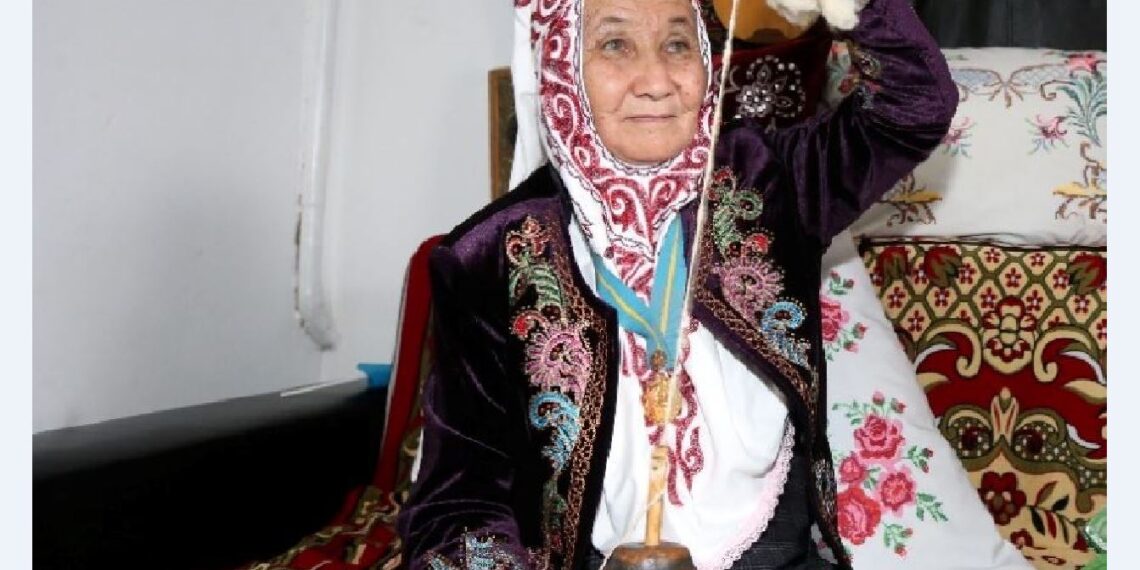
In the city of Taldykorgan lives a woman named Aueskhan Mazhai, who has preserved and passed down to the present day the centuries old heritage of her family. The «Алтын алқа» medal shines on her chest, and last year she received another prestigious state award. It was personally presented to her by President of Kazakhstan Kassym Jomart Tokayev during his working visit to the Zhetisu region. On that occasion, the Head of State noted that the heritage of the family preserved by Aueskhan Mazhaiqyzy was so extensive and valuable that it could fill an entire museum.
Indeed, for many years Aueskhan Mazhaiqyzy has carefully safeguarded the centuries old legacy of her family and, overcoming numerous difficulties at the border, brought it from China back to the ancestral homeland.
«The Andas family had held positions of authority for generations and was respected by people both near and far. Our elders often told us about our ancestors: about Qudainazar Batyr, who went to war against the Dzungars with one hundred warriors and died in battle; about Yesengeldi Bi, one of the first Kazakh envoys and peacemakers to meet the Qianlong Emperor of the Qing dynasty; about his younger brother Sultangeldi Myrza; about Ultaraq Batyr, who fought against the Chinese colonial forces alongside Qarakerai Qonys Batyr; and about Zhansarbay, a healer who treated people suffering from severe illnesses. There was even a saying among the people: If a life can still be saved, Zhansarbay will save it.»
«Unfortunately, in 1952, during collectivization in China, our ancestors were persecuted and all their property was confiscated. We also suffered greatly during the Cultural Revolution, which began in 1966. I married into this family in 1969. From 1969 to 1976, our home was searched three times. It had already been raided several times before I came. The Red Guards took everything they could, even the spoons from our table, and threw the belongings onto rubbish heaps.»
«At night, my father in law, Omarakyn Zhansarbaiuly, would take me with him. Without letting anyone see us, we brought those belongings back home and hid them in sheds and other outbuildings. Among the artefacts we managed to preserve were even some that had been buried in the ground for forty years before later being dug up.»
Before he died in 1976, my father in law called me to him. He named every artefact he had collected and preserved, wrote down which ancestor each item had belonged to, and had everything placed in a large wooden chest that he had made with his own hands. Then he told me: I was not able to give these things the value they deserved during my lifetime. You must personally take them to the place where they belong. He passed away soon afterwards. I was young at the time and could not understand why he was telling me all this. Only now do I understand the deeper meaning of his final request.
Fulfilling that promise and bringing the family heritage back home was far from easy. To do so, Aueskhan Apa crossed the Kazakhstan China border 90 times.
At first, some border guards would mock her, asking, «Why do you need these old things, Apa? Why not just throw them away?» Others tried to persuade her to sell the artefacts. Nevertheless, step by step, she managed to bring home the entire collection that her father in law had once gathered and hidden in the black wooden chest.
Some large and difficult to transport objects, including an ancient copper cauldron and other old household artefacts, were left at the district museum in Kunes, China.
Today, Aueskhan Apa has more than 700 valuable artefacts in her personal collection. In 2019, as part of the Rukhani Zhangyru programme, she donated around 100 of them to the collection of the Atameken Historical and Cultural Centre, where they were entered into the state register.
Among these unique items are Sultangeldi Bi’s silver plated saddle and horse tack dating from the 18th century; an eagle’s beak belonging to Shakil Aktubituly and dating from the 18th century; the weapons of Ultaraq Batyr from the 19th century; medical instruments and equipment used by the healer Zhansarbay Ultaraquly in the 19th and early 20th centuries; hunting equipment; a samovar made in Russia in the 19th century; horse tack woven by Omarakyn Zangy in the 20th century; and many other historical objects.
After returning to Kazakhstan, Aueskhan Apa did not simply keep these treasures in her home. She took them to exhibitions held in Astana, Almaty, Turkistan, Taraz and Taldykorgan, as well as in towns and districts across the Zhetisu region. By presenting the artefacts to the public, she has introduced people to the history of her family and offered younger generations an example of respect for ancestral heritage.
Her perseverance, her loyalty to her ancestor’s amanat, a sacred trust and responsibility passed on to another person, and her lifelong efforts to bring the family heritage back to its homeland can truly be described as an act of wisdom and devotion.
In Kazakh culture, family values, mutual respect between spouses, and the love between parents and children have always been regarded as priceless treasures. Aueskhan Apa embodies these values and continues to pass them on to her children and grandchildren.
Her husband, Andas Omarakyn, was an accomplished aitys performer who won numerous traditional poetic contests. He was also a historian who studied the history of Kazakhs living outside Kazakhstan and a writer who used his pen as his weapon. Born in 1944 in Kunes, China, he passed away in Taldykorgan in 2015.
Andas Aga was among those who suffered discrimination because of the policies of the state in which he lived. He was labelled the «son of a bai manap» and faced restrictions on his creative work. When he was young, Red Guards burned many of his writings. However, during the final decade of his life, when the political situation in China became more stable, he was finally able to devote himself fully to writing. During that period, he published 17 books on the history of Kazakhs in China. In recognition of his work, he received a state level award from the People’s Republic of China in 2010.
Alongside the family artefacts, Aueskhan Apa also brought her husband’s unpublished literary and historical legacy back to Kazakhstan, several thousand pages of manuscripts that had never made it into print. She preserved and transported every single sheet.
Last year, together with her children, Aueskhan Apa compiled a seven volume collection of Andas Omarakyn’s works. Using her own funds, she published three volumes: «Тарих Талғарында», a collection of historical studies; «Дода», a collection of aitys performances; and «Жылдар ізі», a collection of poetry. Today, these works have become a means of introducing younger generations to Kazakhstan’s national cultural heritage.
The Zhetisu Regional Department of Education and the Andas family have jointly launched a major project called «Andas Omarakyn Readings». Thirty schoolchildren from across the region who are passionate about literature, history, aitys and local studies are taking part. The results of the competition will be announced in the summer.
It is also worth noting that last year, with Aueskhan Apa taking the initiative, a family research and genealogical archive of the Andas family was established at the Zhetisu Regional State Archive. The collection contains 56 archival files, more than a thousand handwritten documents, books and printed materials, as well as original academic dissertations.
«In China, our grandfather was branded an enemy of the people, while my husband was labelled a stinking intellectual who supposedly longed for the Soviet Union. For thirty years, we experienced many different forms of pressure. After the 1980s, when the situation in China became more stable, our lives gradually improved as well. Today, all of my children are following in the footsteps of their ancestors and honouring their father’s trust, she says.»
Today, Aueskhan Apa’s children work in a variety of fields. They graduated from leading educational institutions in both China and Kazakhstan. The members of the Andas family have managed to combine academic pursuits with literary work. Seven of the eight children hold master’s degrees.
Honest work always leads a person forward. Last year, the Andas family, brought together by Aueskhan Apa, became a laureate of the national «Mereili Otbasy 2022» family competition and the first winner representing the newly established Zhetisu Region.
Recently, Aueskhan Apa once again took up a good cause. Using money she had saved from her pension, she subscribed «30 schoolchildren from towns and districts of the Zhetisu region» to the regional newspaper «Жетісу», thus supporting the Kazakh press and encouraging young people to engage with reading and their national media.
«We did not do this because we have a lot of money, nor did we do it to gain fame or recognition. If we want our country to prosper and our people to live in peace and abundance, we must first support spiritual and cultural development. We began this initiative with the hope of encouraging other people to join a cause that belongs to all of us, supporting the spiritual life of our society, she says.»
Today, Aueskhan Apa lives in the village of Erkin, in the city of Taldykorgan. She leads a simple life, advises her children and continues to be an example for her grandchildren.
Bolat Abagan,
Zhetisu Region.
Translated by Amina Sayahatqyzy,
Q-Andas Information Agency.
(To be continued…)