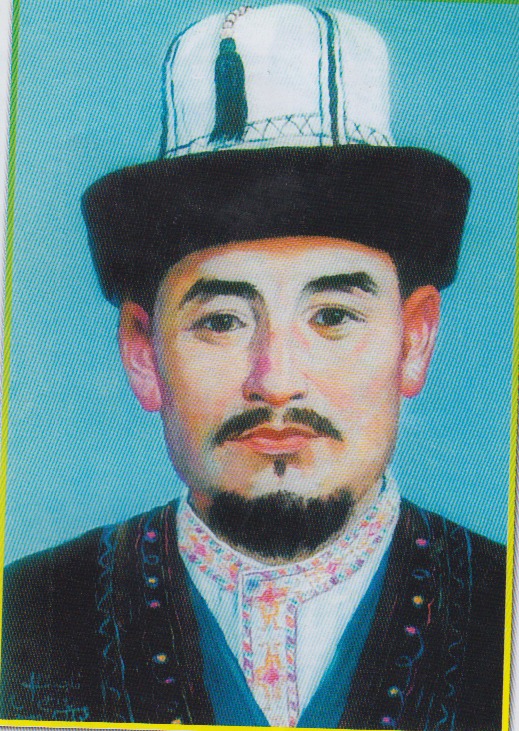
Soltankeldi Qudainazaruly
A story of ancestry, courage, and the wisdom of the elders
Kudainazar Batyr, the second son of Tangirberdi and the husband of Toyyn, was one of the renowned military commanders of Tauke Khan. In 1693, when Galdan Tseren invaded the Kazakh steppes with a large army, Kudainazar first confronted the enemy at the Battle of Kyzylzhar. He and his daughter, Kulanda, rose to defend their homeland. Fighting bravely against the invading forces, they were killed alongside approximately one hundred fellow warriors.
After Kudainazar’s death, Eltai, the son of Kuttymbet, persistently sought to marry his widow, Toyyn, in accordance with the Kazakh custom known as amengerlik. Under this tradition, a widow could marry a relative of her deceased husband, often to preserve family ties and provide for the household.
Unwilling to remain in this situation, Toyyn set out one night with her three sons–Zholymbet, Yesengeldy, and Soltangeldy–to seek refuge among her maternal relatives, the Sary-Uysun, a group associated with the Dulat tribal union.
The three boys later became known as Ush Zhetim, meaning «The Three Orphans.»
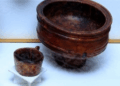
It was late autumn. The family shivered in the cold and struggled with hunger. Exhausted by the journey, the boys repeatedly began to cry. Toyyn comforted them with a traditional saying: «As long as you live, you may yet eat from a golden bowl.»
When Toyyn’s relatives learned that she was approaching with her children, they rode out to meet them and welcomed the family along the road. The three brothers subsequently grew up among the Sary-Uysun, spending their childhood and youth along the banks of the Talas and Shu rivers.
The Young Man Who Settled a Dispute
One day, Kaiyp Bi of the Matai clan and Tobet Bi of the Dortuyl clan travelled to Sary-Uysun territory to resolve a kun dispute–a traditional claim for compensation following a person’s death.
The story behind the dispute was as follows.
A young man from the Qyzai clan was working as a hired labourer for a wealthy landowner. One day, his employer instructed him to break in a spirited, untrained mare. The mare had spent the summer suckling and had grown strong and unruly.
To make the animal accustomed to being ridden, the young man fitted it with a bridle, attached a heavy wooden log around its neck so that it struck against its sides, and placed a coarse felt covering on its back. The covering flapped noisily in the wind. By frightening and exhausting the animal, he gradually attempted to prepare it for riding.
Once the mare seemed ready, the young man mounted it and headed towards the village. At that moment, a crow perched on a wooden stake in an abandoned encampment suddenly took flight. The mare bolted in fright, while the heavy felt covering on its back flapped wildly. The animal bucked, throwing the rider onto a pile of rocks. He suffered a fatal head injury and died.
The deceased man’s kinsmen from the Matai clan appealed to Kaiyp Bi, asking him to secure compensation from the Sary-Uysun. They insisted that the customary compensation for the death of a man amounted to one hundred horses.
Zharylk ap Bi of the Shapyrashty clan, hoping to preserve peace between the two groups, proposed a compromise: the responsible side should pay fifty horses, and the dispute would then be settled. However, the parties argued for two days without reaching an agreement.
Just as the Sary-Uysun appeared ready to accept the compromise and the proceedings seemed about to conclude, a tall, fair-haired young man sitting at the edge of the gathering leaned to one side, disrupting the course of the discussion. The dispute resumed. The same thing happened the following day, and the pattern continued for three days.
Noticing this, Kaiyp Bi summoned the young man on the fourth day and invited him to give his own ruling.
The young man spoke:
«One hundred horses as compensation for a man’s death is the rule recognised today. Yet this case involves four contributing parties.
«First, there are the wooden stake and the crow. Those who left the encampment without pulling the stake out of the ground bear responsibility.
«Second, there is the untrained mare.
«Third, there is the employer who provided the labourer with the coarse felt covering that flapped on the animal’s back.
«Fourth, there is the wealthy owner who ordered the young man to break in a wild mare without assigning anyone to assist him.
«The hundred horses must therefore be apportioned among these four parties. Twenty-five horses should be attributed to the stake and the crow, another twenty-five to the mare, and another twenty-five to the felt covering. But, as the saying goes, ‘A dog does not bark at a bowl with no owner.’ These seventy-five horses should be remitted. The owner need pay only the remaining twenty-five.»
With this reasoning, the young man delivered his verdict.
Impressed by the wisdom of the decision, Kaiyp Bi began asking who the young man was. When he discovered that the young man was his own kinsman, he exclaimed:
«Why should I mourn a crane when I have a falcon of my own? Why search for a hawk when my own hunting falcon is at hand?»
His words expressed his joy at finding a worthy member of his family who could carry forward its legacy. He abandoned his claim in the dispute, embraced Toyyn with tears in his eyes, and asked the Sary-Uysun to let him take the three boys back to his own village.
Gifts That Foretold the Brothers’ Destinies
There is a Kazakh saying: «Nagashy zhurt synshyl»–«Maternal relatives are discerning judges of their nephews.»
The Sary-Uysun elders, led by Zharylk ap, followed this tradition when bidding farewell to the three brothers. They presented each boy with a symbolic gift: Zholymbet received a wooden pole used for household and agricultural work, Yesengeldy was given a spear, and Soltangeldy received a saddle and horse tack.
In retrospect, these gifts seemed to foreshadow the paths taken by their descendants. Many of Zholymbet’s descendants became entrepreneurs and successful people in commerce and economic life. Yesengeldy’s line produced renowned batyrs–warriors and military leaders who commanded troops. Among Soltangeldy’s descendants were eloquent speakers, respected biys who served as judges and community leaders, administrators, and writers.
In 1760, Yesengeldy accompanied an embassy sent by Abylai Khan to the Qing Empire. The Kazakh envoys were received by the Qianlong Emperor at his summer residence in Rehe.
During the imperial banquet, food was served in gilded vessels. When Yesengeldy saw the golden tableware, he suddenly smiled.
The emperor’s attendants noticed and asked him:
«Have we made some mistake?»
In response, Yesengeldy Bi told them the story of the Three Orphans and explained why the sight had reminded him of his family’s past.
The Brothers’ Military Service
During Abylai Khan’s campaign against the Kyrgyz leader Atake Zhyryk, Yesengeldy and Soltangeldy were appointed to lead a reconnaissance detachment. Abylai Khan recognised that the brothers knew the local terrain well and could use their knowledge to guide scouts through the area.
This episode further illustrates the importance of their geographical knowledge, powers of observation, and ability to make sound decisions.
The Silver Saddle of Soltangeldy
The silver saddle associated with Soltangeldy Baba was passed down through generations and eventually came into the possession of the descendants of Shakil, the youngest son entrusted with the ancestral household.
In Kazakh tradition, the youngest son often remains in the parental home and carries on the family line. The ancestral home is known as the karashanyrak, the principal household that symbolises family continuity and the preservation of ancestral heritage.
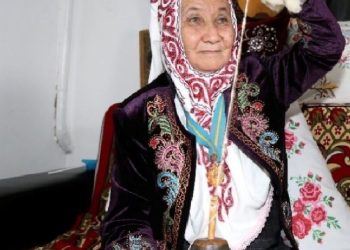
During China’s Cultural Revolution in the 1960s, the saddle was discarded among objects destined for destruction. However, Aueskhan Mazhaikyzy managed to hide it and preserve it for future generations.
The saddle’s historical value lies not only in its age and the story of its transmission across generations, but also in the intricate ornamentation of its silver-plated front section.
Kazakh ornamental art has a long history and follows distinctive artistic conventions. The designs used on the silver fittings of traditional saddles can be studied in relation to the differences between ornamentation traditionally associated with men’s and women’s saddles. Many of these designs belong to the family of linear patterns.
Among the motifs on this saddle are shapes resembling a crescent moon and star-like forms. Traditionally, the front pommel of a woman’s saddle could feature three or five raised decorative elements, while the pommels of men’s saddles were often framed with a single or double continuous line.
The silver-plated section of Soltangeldy’s saddle corresponds to the decorative conventions associated with men’s saddles.
Today, this artefact holds exceptional value for the study of Kazakh genealogy, traditional saddlery, and national ornamental art. It deserves further examination by ethnographers, historians, and emerging researchers.
The silver saddle of Soltangeldy is more than an antique object. It is a tangible testament to ancestral memory, the continuity of generations, and the cultural heritage of the Kazakh people.
Author: Kazhet Andas
Translated by: Amina Sayahatkyzy
Q-Andas News Agency
(To be continued…)