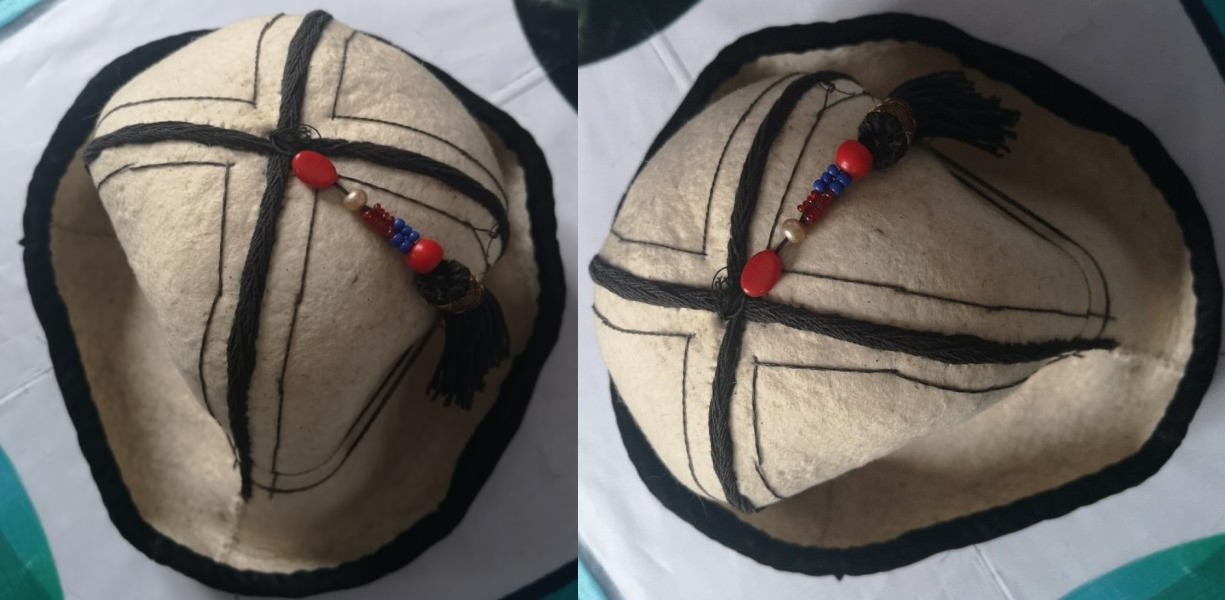
Qyzai Ana is one of the respected and revered maternal figures of the Kazakh people. Her given name was Kunbike. Her father was Baydibek Bi Qarashauly, a prominent figure of the Senior Zhuz, while her mother was Domalaq Ana, the daughter of Maqtim Agzam, who served as the imam of the Bab-Arab Mosque in Turkistan. Thus, Qyzai Ana inherited her noble lineage and many of her admirable qualities from her parents. Her wisdom and gift of foresight amazed those around her.
At the age of seventeen, she married Shagyr Batyr, the son of Jandaulet Bi, and became the mother of four sons – Itemgen, Menis, Begimbet and Derbis. In latergenerations, their descendants came to be known as the Qyzai, in honour oftheir mother. During the years of the great tragedy known as «Aqtabаn shubyryndy, Alqakol sulama», the Qyzai people lived for some time along the Syr Darya. Later, by order of Khan Abylai, they migrated eastward. Today, more than 700,000 Qyzai people live in the Ili region of China. When Qyzai Ana was approaching the age of forty, she called her four sons – Itemgen, Menis, Begimbet and Derbis – to her and
said: Two mighty baitereks – your father Shagyr and Toqtarqoja – fell one after another, and in the end, the four of you remained.
For this, too, we must give thanks to the Almighty. There is an old saying: «Those who share the same lineage do not turn against one another; those who share the same roots do not go their separate ways.» You four share
the same lineage and the same roots. If you remain united, if you stand
together like a single fist, you will grow, prosper and flourish. Each of you
will become a mighty baiıterek.
And when that time comes, people from all
around will gather around you, and those who once stood above you will
themselves turn towards you. «The honoured mother then continued:» To
serve as a symbol and sign of your unbreakable unity, I have made a white
kalpak for you from the finest and softest wool of a white sheep.
It has four panels, representing my four children. I have brought the four panels together at the crown – may all four of you remain whole and united, with your heads joined together as one. I have attached seven pearl tassels to the top. May they protect you from the evil eye and make your sworn enemies fear you. Around the kalpak, I have sewn two rows of loops so that it can be made wider or
narrower.
This is my wish that you should always be generous, patient and
understanding towards one another. I have trimmed the edge with black velvet.
May your people become as numerous and closely gathered around you as a dense
dark forest. Finally, I made the kalpak white, using pure white felt. By this,
I wish for you to grow and prosper at the foot of the white-capped Alatau – in
the ancestral homeland of my forefather Baydibek – to drink from its clear
springs, rest in its green meadows and live a pure and blameless life, as white
as snow…”
The Traditional Crafting of the Qyzai Kalpak
The Qyzai kalpak has its own distinctive method of production and decoration. It is traditionally made from wool taken from the neck area of a white sheep, which undergoes several stages of careful preparation. First, the coarse hairs are removed from the wool, leaving only the soft underwool. It is then thoroughly washed and dried. After that, the wool is teased apart and spread evenly over a «shiy» – a traditional reed mat – in a circular shape,
forming a layer of the required thickness. The prepared wool is then rolled
together with the reed mat and worked by hand until the fibres begin to bind
and form felt. Once the material has sufficiently felted, it is further rolled
and compacted using a special wooden roller.
The surface is then sprinkled with inely ground white chalk, and the material is worked in a circular motion until the felt becomes dense and takes on a rounded, bowl-like shape. It is subsequently washed with hot water to remove impurities and then left to dry. Once the felt has dried, it is smoothed out. The centre is measured and the material is cut into four panels. For example, in a size 57 kalpak, the overall height of each panel is 29 cm, the width of the upper turned-back section is 11 cm, the diagonal length of the panel is 30 cm, and the width of its lower part is 21 cm. The width of the turned-back section is 19 cm, its height is 8 cm, while the width of its decorative trim is 16 cm. Following these measurements, the crown and side sections are cut, with their edges gradually narrowing towards both the upper and lower parts. It should be noted that the dimensions of the kalpak vary according to its size. Experienced craftswomen may adjust the measurements according to their own preferences and the size required for the particular wearer.
After the pieces have been cut, the four edges of the kalpak are joined and secured, forming the characteristic structure of the headwear. Decorative embroidery and traditional ornamental patterns are then added to the joined sections. The edge of the kalpak is finished with black fabric. For this purpose, the fabric is cut on the bias – neither along nor across the grain – and the resulting strips are joined together and used to finish the edge.
The surface of the kalpak is coated with white chalk. This treatment helps protect the headwear from moisture and sunlight while also
preserving its original white colour. The Qyzai kalpak is based on the
traditional «aiyr kalpak», a Kazakh style of headwear distinguished by the
division of its side sections. At the same time, the Qyzai version has its own
decorative features, including embroidered and appliquéd elements and
traditional ornamental patterns. These details give the kalpak its distinctive
and elegant appearance. Thus, the Qyzai kalpak is more than a traditional item
of clothing. It is also a symbolic representation of unity, kinship and
continuity between generations. Its shape, colour, ornaments and individual
elements carry meanings rooted in traditional beliefs about family, unity,
protection and prosperity.
Author: Kazhet Andas
Translated by Amina Akylbek,
Q-Andas Information Agency.
(To be continued…)