 Ultaraq Aqtubituly
Following the adoption of the Statute on the Siberian Kirghiz in 1822, the Russian Empire announced the establishment of eight external administrative districts across territories inhabited by Kazakhs. Subsequently, the Ayagoz District was established in 1831; the Akmola and Amankaragаy districts in 1832; the Bayanaul and Ushbulak districts in 1833; the Karkaraly and Kusmurun districts in 1842; and the Kokpekti District in 1844.
At the same time, the Qing Empire of China began to turn its attention towards the Kazakh steppe. Ultimately, Russia and China pursued their own interests, concluding a series of unequal agreements that affected the region. These included the Regulations on Trade between China and Russia in the Ili and Tarbagatai Regions in 1851, the Treaty of Beijing between China and Russia in 1860, and the Treaty of Ili in 1881. Through these agreements, the two imperial powers began dividing the ancestral lands of the Kazakh people between themselves. There was no effective authority to intervene or defend the interests of the local population.
Tragically, not a single representative of the Kazakh clans that had inhabited and regarded these territories as their ancestral homeland for generations took part in any of these negotiations. As a Kazakh proverb suggests, «A dog will not give away even a weed for nothing.» Russia and China divided the land according to their own interests, sowing discord and unrest among its inhabitants.
The Kazakh batyrs–warriors renowned for their courage and their defence of their homeland–did not remain passive in the face of this injustice. Resistance against colonial expansion arose in different parts of the Kazakh steppe. Among the prominent leaders associated with these struggles were Isatay and Makhambet, Kenesary, Zhankozha and Estai. The Tarbagatai region also became a theatre of armed resistance.
The Syban clan, led by Sybankul, took up arms against Russian expansion, while members of the Karakerei clan rose against Chinese rule under the leadership of Kurban Haji, also known by the nickname Koniz. In Chinese archival records, the uprising led by Kurban Haji (Koniz) is referred to as the Revolt of Bor Batyr and Koniz. The resistance led by Sybankul, meanwhile, was recorded as the Baizhigit Uprising.
The Resistance in the Tarbagatai Region
From the 1860s onwards, Kazakhs living on the southern slopes of the Tarbagatai Mountains suffered considerable oppression at the hands of Chinese troops and local Dungan communities. Unable to endure these abuses any longer, Kazakh warriors began rallying around Kurban Haji (Koniz) and the batyr Kazakhbai Komesh. They were joined by a force led by the Dungan commander Bor Batyr.
When they heard that members of the Zhumyk clan were gathering forces to fight the Chinese, Alibek Batyr, a descendant of the renowned Kazakh commander Kabanbai, came to their aid. He was accompanied by Batyr Kul, associated with the Otynshy warriors, and by the biy Tokyr, a respected traditional judge and community leader.
Young warriors from the Kyzai clan also joined the campaign under the leadership of Baiyeke, a local administrative leader.
According to the historical account, they launched their campaign against the Chinese army on the twenty-seventh day of the first month of 1860, following the traditional calendar. The fighting continued for three years. The Chinese forces resisted with an army that included Oirats and Mongols under the leadership of the Oirat religious and political figure Shagan Gegen, as well as Kalmyks, Manchus, Sibe and Solon troops.
For three years, the Kazakh batyrs fought fiercely, enduring battles in which, according to traditional accounts, they were knee-deep in blood. The oral tradition maintains that the Kazakh forces eventually drove Chinese troops out of the Altai, Ili and Tarbagatai regions, pushing them beyond the Yerenkhabirga Mountains.
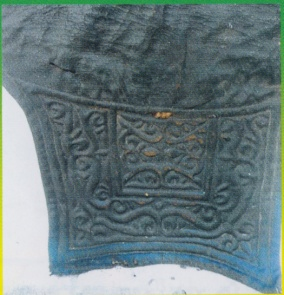
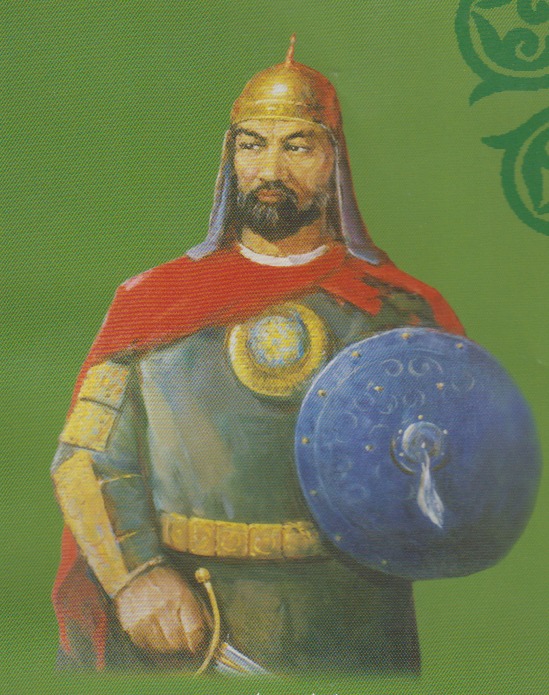
Among those who took part in these events was UlТarak Aktybituly, the batyr whose legacy is preserved through the leather saddle cloth described here.
UlТarak Batyr: His Life and Deeds
According to accounts passed down by the elders, UlТarak Batyr lived from 1801 to 1889. He was remembered as a determined, uncompromising and strong-willed man, known for his direct manner, proud character and refusal to retreat when confronted by an adversary.
Despite the many deeds of bravery attributed to him, UlТarak remains relatively little known today, and his contribution has received limited attention in historical and educational publications.
UlТarak was born in the foothills of the Kalba Mountains, in what is now Zharma District of East Kazakhstan Region. He spent his childhood, youth and later years among members of the Kyzai clan, whose traditional settlements and grazing lands extended across Tarbagatai, Maili-Zhair and Toktabarlyk.
In 1839, UlТarak took part in a battle against a force of 900 men led by Sybankul, the son of Khankozha. According to the account, this force had set out to attack and seize the settlements of the Kyzai clan.
During the 1860s, UlТarak also participated in the uprising associated with Bor Batyr in the city of Chuguchak, known today as Tacheng in China’s Xinjiang Uyghur Autonomous Region. In this struggle, Kazakhs and Dungans joined forces against the colonial policies of the Qing Empire. UlТarak distinguished himself through his courage and military service.
The Sacred Bond Between UlТarak and Andas
Family tradition recounts that during the uprising led by Koniz Batyr, UlТarak formed a bond of brotherhood with Andanas, also known as Andas, a batyr of the Karakerei clan.
Their friendship was sealed through a traditional gesture in which the two men pressed their chests together, symbolising mutual respect, trust and an enduring commitment to stand by one another.
According to the oral account, Andas later met his death after falling into a difficult situation during the turbulent events of the period. Following his death, his horse equipment and other personal belongings were distributed among his close companions by Koniz Batyr of the Karakerei clan. The leather saddle cloth described in this account was among the items given to UlТarak.
Before his own death, UlТarak left his descendants a special instruction: one of his children or future descendants was to be named Andas, in memory of his sworn brother.
This wish was fulfilled in 1944, when the author of this family account was born. His grandfather, Zhansarbai, who was ninety-three years old at the time, gave the child the name Andas, preserving the memory of the friendship between the two batyrs.
The Ornament and Its Historical Significance
The elders maintained that the decorative pattern on UlТarak’s leather saddle cloth was identical to the ornament bordering the battle standard of Koniz Batyr. According to local oral tradition, the standard itself still exists and is believed to be held by someone in the community.
The saddle cloth was passed down through successive generations. It was inherited by UlТarak’s son, Zhansarbai, who was known as a traditional healer, and subsequently passed to Oмарakyn Zangi, a local leader who held an administrative title.
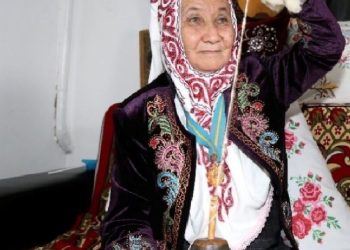
Today, the leather saddle cloth represents more than an item of traditional horse equipment. It is a family heirloom associated with the memory of UlТarak Batyr, the struggles of the Kazakh people, the bond of sworn brotherhood between warriors, and the preservation of ancestral heritage through generations.
Its ornament is especially significant in family tradition because it is believed to connect the saddle cloth with the battle standard of Koniz Batyr. Together, the object and the story passed down with it offer a glimpse into the historical memory, material culture and oral traditions of the Kazakh people.
Author: Kazhet Andas
Translation: Amina Sayahatkyzy
Q–Andas News Agency
(To be continued…)