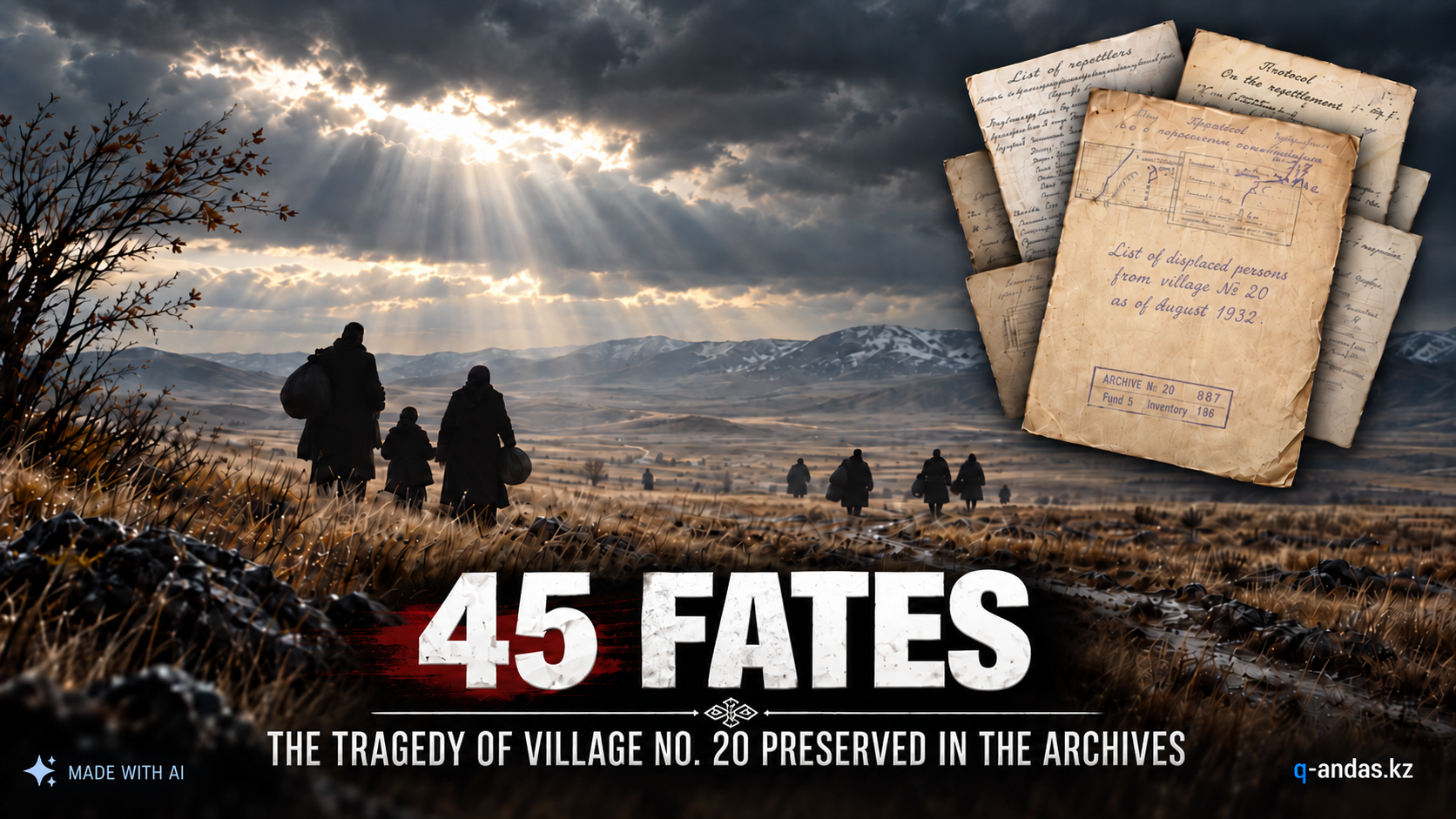
The archival document contains the names of 45 people associated with Aul No. 20, the composition of their families, their social status, occupations, military service, deprivation of voting rights, arrests, and the charges brought against them. Although some words in the document are not clearly legible, its overall content clearly demonstrates the criteria by which the Soviet authorities persecuted the residents of the aul.
This list is not merely an ordinary reference document. It reflects the tragedy not only of a single aul but also of Kazakh society during the period of forced collectivization, confiscation of livestock and property, grain and meat procurement campaigns, suppression of uprisings, and the mass punishment of people deemed politically unreliable.
Persecution Based on Social Origin
Most of the people named in the document are described using such social classifications as “Kazakh bai,” “biy,” “major bai,” “mullah,” “alien element,” and “a person originating from the bai class.” For the Soviet authorities, it was not whether a person had committed a specific crime that mattered, but rather that person’s social origin.
For example, Aubai Basybekov, Askarbek Bubai Basybekov, Askarbek Bamerkhan, Inasbai Ausbayev, Ragtem Turkmenov, and many others were identified as a “Kazakh biy” or a “Kazakh bai.” Although Abil Chilataliev’s social background was recorded as “livestock breeder,” he was also placed under surveillance. Tokuba Tatanova was accused of “originating from the bai class,” while Suleimen Nuraliyev was accused of “originating from a bai lineage.”
The designations bai or biy do not prove that these individuals were necessarily major exploiters. Wealth in a Kazakh aul was generally measured by the number of livestock owned. Even possessing enough livestock to support one family could have provided grounds for classifying a person as a “bai.” Those known as biys were respected figures in traditional Kazakh society who resolved disputes within the community. The Soviet authorities regarded such influential individuals as representatives of the former social order and as threats to the new system.
Thus, the terms “bai,” “biy,” and “mullah,” which signified authority and responsibility in traditional Kazakh society, became instruments of political accusation in Soviet documents.
Deprivation of Voting Rights
The designation “lishenets,” meaning a person deprived of voting rights, appears frequently in the document. This designation signified the restriction of a person’s civil and political rights.
Aubai Basybekov and Askarbek Bamerkhan were deprived of voting rights under the October resolution. Inasbai Ausbayev, Ragtem Turkmenov, Magzumgali Seilbai, Myrza Ali Zhumagaliyev, Baimyrza Shemshibekov, and other citizens are also listed among those deprived of voting rights.
The deprivation of voting rights was not limited to a prohibition on voting. Such people:
– could not obtain employment in public service;
– were not admitted to public organizations;
– faced obstacles in obtaining an education and employment;
– were excluded from the distribution of food and social assistance;
– were classified as politically unreliable together with members of their families.
Therefore, the single word “lishenets” meant that a person had been excluded from all areas of public life. This punishment became a form of social pressure applied even before a court verdict had been issued.
Punishment for Opposing Forced Collectivization
One of the most frequent accusations in the document is that of conducting agitation against collectivization and collective farms.
Sultan Aidarbekov was accused of “conducting agitation against collectivization.” Eskendir Tlekeshev is described as “an active participant in the anti-collective-farm movement.” Baimyrza Shenasypov, Kuldiyan Kurmanbayev, Baimyrza Shemshibekov, Toleubek Kappetzhanov, and the person whose name was crossed out were also accused of conducting agitation against collective farms or collectivization.
However, it must be taken into account that the concept of “hostile agitation” had a very broad scope. Refusing to join a collective farm, refusing to surrender livestock into common ownership, expressing dissatisfaction with grain and livestock delivery plans, urging fellow villagers to exercise caution, or criticizing the authorities’ demands could also be assessed as “anti-Soviet agitation.”
For centuries, Kazakh society had been adapted to nomadic and semi-nomadic livestock farming. The policy of collectivization forcibly transformed this established economic system within a short period of time. The seizure of livestock meant not only the loss of private property but also the deprivation of a Kazakh family’s principal means of subsistence. Therefore, interpreting every action against collective farms as political hostility does not fully reveal the historical reality. Most of these actions represented the natural resistance of people attempting to preserve their livelihoods, families, and livestock.
Persecution for Failure to Fulfil the Grain Procurement Plan
Accusations associated with grain and food procurement campaigns occupy a distinct place in the document. Aubai Basybekov and Askarbek Bamerkhan are described as having “conducted agitation against grain procurement.” Sultan Aidarbekov was also accused of opposing grain procurement.
Myrza Zhumabekov and Sadybek Butekenov were arrested and brought to trial for failing to fulfil the food procurement plan. Tolepbergen Shakubayev was held accountable for failing to fulfil the procurement plan. The person whose name was crossed out was convicted under Article 61 of the Criminal Code on the same charge.
The plan imposed on the residents of the aul may not have corresponded to their actual economic capacity. If a person whose livestock and grain had been confiscated, and whose family faced the threat of starvation, was unable to fulfil the plan, that person was accused of “deliberate non-compliance,” “concealing grain,” or “hostile agitation.”
Thus, the inability to fulfil an economic obligation was transformed into a political crime. The reasons for failing to fulfil the plan – insufficient livestock, zhut, poverty, or the family’s subsistence needs – were disregarded. The state plan was placed above human life.
Accusations of Participation in an Uprising
Several people in the document are described as “participants in an uprising” or “active participants in an uprising.”
They include:
– Inasbai Ausbayev;
– Ragtem Turkmenov;
– Lesha Anisimovich Ogar;
– Sultan Aidarbekov;
– Magzumgali Seilbai;
– Myrza Ali Zhumagaliyev;
– Baimyrza Shenasypov;
– Koishankei Kuzhabayev;
– Bergalibi Shabdenov;
– Turatbai Sandybayev.
Soviet documents often explained the principal causes of uprisings as “provocation by the bais,” “counter-revolutionary activity,” or “resistance to Soviet authority.” However, the accusations contained in the document cannot be considered separately from the coercive measures of that period.
The confiscation of livestock and property, forced admission into collective farms, pressure on religious beliefs, excessive taxation and procurement plans, and restrictions on free migration caused discontent among the rural population. Therefore, a substantial number of the uprisings represented popular resistance aimed at protecting livelihoods, the traditional way of life, and families, rather than attempts to seize political power.
In the document, Sultan Aidarbekov and Mikhail Karpilovich were accused of “participating in the March datsan uprising.” This demonstrates that the Soviet authorities regarded both protests against collectivization and protests of a religious nature as political threats.
The Charge of “Anti-Soviet Agitation”
The document repeatedly contains accusations of “anti-Soviet agitation,” “activity against the authorities,” and “conducting anti-Soviet propaganda among Kazakhs.”
Sultan Aidarbekov was accused of conducting anti-Soviet agitation among the residents of the aul. Koishankei Kuzhabayev and Bergalibi Shabdenov were accused of spreading anti-Soviet propaganda among Kazakhs. Turatbai Sandybayev is described as a person who was “against the authorities.”
A specific written appeal or organized activity was not necessarily required to substantiate such accusations. Words criticizing the authorities, an opinion opposing entry into a collective farm, dissatisfaction with the requirement to surrender grain, or a conversation about the difficult conditions in the aul could also be interpreted as anti-Soviet agitation.
Article 58-10 of the Criminal Code was applied to anti-Soviet agitation and propaganda. The document indicates that Inasbai Ausbayev, Ragtem Turkmenov, Sultan Aidarbekov, Toleubek Kappetzhanov, Makhtuma Sultanbekova, and other citizens were persecuted on charges of this nature.
The generalized wording of the accusations indicates that the investigation did not fully specify the exact words spoken or actions committed by the accused. Instead of comprehensively proving the actions of a particular individual, ready-made definitions such as “agitator,” “active participant,” and “hostile element” were used.
Persecution Based on Religious Activity and Beliefs
Bekas Yusupovich and Murtaz Yusupovich are identified in the document as “mullahs.” Vasen Fashanov is described as a “haji who observed fasting.” The presence of individuals associated with the datsan uprising also indicates that religious representatives and religious communities were placed under surveillance.
Soviet policy regarded traditional religious institutions as obstacles to the new ideology. Mullahs, hajis, and people with religious knowledge possessed authority and could influence the residents of the aul. Therefore, their religious activity became an indicator of political unreliability.
Performing the Hajj, observing a fast, or being a mullah does not in itself constitute a crime. Nevertheless, the deliberate inclusion of such information in a political registration document demonstrates that a person’s religious beliefs were also grounds for surveillance, and the deliberate inclusion of such information in a political registration document demonstrates that a person’s religious beliefs were also grounds for surveillance and persecution.
Persecution for Former Political and Military Activity
Myrza Zhumabekov is recorded as having served in the White Army. Murtaz Yusupovich was accused of participating in the Basmachi movement. It is specifically noted that some individuals had been Cossacks or atamans.
For a long time, the Soviet authorities regarded people with any connection to former political structures, the White Army, or the Basmachi movement as unreliable. In some cases, information about a person’s former activities became the basis for a new criminal case even decades later.
The family members of people in this category were also investigated. The repeated questions in each person’s questionnaire – “Did this person serve in the army?” and “Were there any family members who served in the army?” – demonstrate that the authorities monitored not only the individual but also the individual’s entire family circle.
Family Members Also Falling Under Political Suspicion
The documents list each person’s wife, children, mother, older and younger brothers, daughter-in-law, and even nephews. This information was not collected solely for demographic records. The Soviet punitive system considered a person’s social environment, family connections, and the family’s former status together.
Tokuba Tatanova was accused of “originating from the bai class,” while Suleimen Nuraliyev is described as “originating from a bai lineage.” Here, a person’s origins, rather than a specific action, became the basis of an accusation. Women were also classified as “alien elements” because of the social status of their husbands or families, deprived of voting rights, and placed under NKVD surveillance.
The inclusion in the list of children aged three, two, and even one year demonstrates that repression was not limited to a single person. A family whose father had been arrested or whose livestock and property had been confiscated lost its provider, home, and means of subsistence. Therefore, the consequences of political punishment were borne by the entire extended family, from infants to the elderly.
The Transformation of Criminal Code Articles into Instruments of Punishment
The document principally reveals two categories of legal accusations:
– Article 58 of the Criminal Code and its Section 58-10 – actions, agitation, or propaganda against the Soviet authorities;
– Article 61 of the Criminal Code – an accusation applied in connection with the failure to fulfil state obligations and procurement plans.
I n most cases, no specific evidence is provided alongside the cited articles. Instead, brief definitions such as “agitator,” “participant in an uprising,” “opponent of the authorities,” “bai,” and “alien element” are given.
In these cases, legal assessment and political directives became indistinguishable. Economic hardship, social origin, and dissatisfaction with the authorities were equated with criminal activity. As a result, the courts and investigative authorities were transformed from institutions intended to establish justice into instruments for implementing a political campaign.
What Do the Contradictions in the Document Indicate?
The document contains several clear contradictions. The years of birth and ages of some individuals do not correspond. For example, a person born in 1920 is recorded as being 46 or 56 years old. Some names are distorted, social status is recorded ambiguously, and several words are entirely illegible.
Such errors cannot be regarded merely as technical shortcomings. They may indicate that the lists were compiled in haste, that the information was verified only superficially, or that it was distorted during the subsequent transcription of the document. Most importantly, even in documents that determined people’s fates, insufficient attention was paid to factual accuracy.
However, an incorrectly recorded age or name does not mean that the person was not persecuted. On the contrary, it suggests that within the punitive system, the socio-political label imposed upon an individual was more important than that person’s actual biography.
At the same time, this list is not a complete collection of court judgments. Alongside those who were accused, it includes individuals who were investigated, registered, released, or remained at home. Therefore, to determine the ultimate fate of each person, it is necessary to examine separately that person’s individual investigation file, court judgment, and subsequent rehabilitation documents.
The Truth About the Calamity That Befell the Kazakh People
The greatest truth revealed by this archival list is that repression was not directed solely against prominent political figures. Its victims included livestock breeders, poor peasants, middle peasants, bais, biys, mullahs, hired labourers, women, and elderly people. Some individuals were persecuted not for specific actions but because of their social origin, family connections, traditional authority, or opinions that displeased the authorities.
The calamity that befell the Kazakh people unfolded simultaneously in several forms:
– they were deprived of their livestock and property;
– the traditional economic system was destroyed;
– the ability to migrate freely was restricted;
– they were deprived of voting and civil rights;
– they were forcibly incorporated into collective farms;
– they were accused of participating in uprisings or conducting agitation;
– they were imprisoned, exiled, or sentenced to death;
– their families were also classified as “unreliable.”
The document concerning Aul No. 20 lists all the members of each person’s family. This proves that repression affected not only the arrested individual but the entire household. A child deprived of a father, a woman deprived of a husband, and a family deprived of its livestock faced starvation, displacement, and social exclusion. The names of three-year-old, two-year-old, and even infant children in the document appear as silent witnesses to this family tragedy.
It would be inconsistent with historical truth to characterize all these people equally as “enemies of the state.” A considerable number of the accusations in the document indicate not that they were criminals but that they were unable to adapt to coercively implemented policies or resisted them. A person who sought to protect livestock, family, faith, and an established way of life became a political opponent in the eyes of the Soviet system.
The archival document concerning the residents of Aul No. 20 reveals the systematic nature of Soviet repression. Punishment was based not primarily on a specific crime committed by an individual, but on social origin, wealth, occupation, religious beliefs, family connections, and attitudes toward state campaigns.
First, the population was divided into such categories as bai, biy, mullah, kulak, and alien element. Their voting and civil rights were then restricted. Their livestock and property were confiscated, and their households were ruined. Those who refused to join collective farms or fulfil excessive plans were regarded as political criminals. Those who resisted were called insurgents, while those who expressed their opinions were labelled anti-Soviet agitators.
The names in this document are not mere statistics. Behind each name stands a broken household, an orphaned child, a family deprived of its means of subsistence, and the fate of a person separated from their native land. This is the truth of repression in the Kazakh steppe: the traditional life of an entire people was forcibly transformed, and thousands of individuals who refused to submit to those changes or fell under suspicion were punished as criminals.
Therefore, this list should be regarded not merely as a record of accused individuals, but as historical evidence of the social, spiritual, and demographic calamity that befell Kazakh society.
Kazhet Andas,
Q-Andas News Agency.
No. 20 Aul
- Surname, First Name, Patronymic: Aubai Basybekov
Born in 1880, aged 56.
Family composition:
Wife – none.
Son, Kozhan – 23 years old.
Daughter-in-law, Kalima – 21 years old.
Kazakh biy.
Deprived of voting rights under the October resolution.
Livestock breeder.
Did not serve in the army.
No family members served in the army.
Brought to trial under Article 61 of the Criminal Code.
Agitator against grain procurement.
“Komlestirovannyi” [unclear in the original].
14 July 1931.
Verified by the investigator.
Criminal investigation.
- Surname, First Name, Patronymic: Askarbek Bamerkhan
Born in 1881, Aul No. 20.
Family composition:
Wife, Kalima – 42 years old.
Daughter, Ryskansha – 12 years old.
Son, Karim – 3 years old.
Kazakh biy.
Deprived of voting rights under the October resolution.
Livestock breeder.
Did not serve in the army.
No family members served in the army.
Brought to trial under Article 61 of the Criminal Code.
Agitator against grain procurement.
“Komlestirovannyi” [unclear in the original].
14 July 1931.
Verified by the investigator.
Criminal investigation.
- Surname, First Name, Patronymic: Inasbai Ausbayev
Born in 1882.
Family composition:
Wife, Aisha – 31 years old.
Son, Kazybek – 9 years old.
Kazakh biy.
Disenfranchised person.
Livestock breeder.
Did not serve in the army.
No family members served in the army.
Arrested by the OGPU on 5 August 1930 under Article 58-10, Part 1, of the Criminal Code.
An active participant in the uprising.
Signature: Zamotkovsky.
Arrested and removed by OGPU officer Makarov.
- Surname, First Name, Patronymic: Ragtem Turkmenov
Born in 1882, Aul 1/520.
Family composition:
Presumably, wife Marzogul – 41 years old.
Daughters: Makhabat – 33 years old; Fatima – 20 years old.
Son, Kadyralin (?) – 36 years old.
Kazakh biy.
Disenfranchised person.
Livestock breeder, “Taj head” [unclear in the original].
Did not serve in the army.
No family members served in the army.
Arrested by the OGPU on 5 August 1930 under Article 58-10, Part 1, of the Criminal Code.
Participant in the uprising.
Removal by OGPU officer Makarov.
Arrested by the District OGPU.
- Surname, First Name, Patronymic: Lesha Anisimovich Ogar
Born in 1920.
Conscripted by the District Military Commissariat on 20 August 1942.
Family composition:
Wife, Savashina – 31 years old.
Son, Kalin – 6 years old.
Was a Cossack.
Ataman.
Released as having not served.
Resettled or transferred.
Place or unit.
“Putina” [unclear in the original].
Participant in the uprising.
Interrogation record dated 6 August 1942.
Signature: Makarov.
- Surname, First Name, Patronymic: Lesha Anisimovich Ogar
Born in 1920.
Conscripted by the District Military Commissariat on 13 August 1942.
Family composition:
Wife, Oksanka – 33 years old.
Son, Sergei – 5 years old.
Daughter, Lyuba – 3 years old.
Was a Cossack.
Ataman.
Released from the army as the father of a family.
Resettled to …
Place of residence: OPPU 58210 dated 4/42.
Participant in the uprising.
Makarov.
- Surname, First Name, Patronymic: Sultan Aidarbekov
A native of Aginskaya village, Aginsky District, Buryat-Mongolian ASSR.
Born in 1920.
From a poor-peasant family.
Dekulakized in 1930–1931.
Member of the All-Union Leninist Young Communist League since 1939.
Was not in service.
No family members had criminal convictions.
Arrested by the Aginsky District Department of the NKVD on 5 August 1940.
Charges:
Agitator against collectivization.
Participated in the March datsan uprising.
Conducted anti-Soviet agitation among the villagers.
Spoke against grain procurement.
Criminal Case No. 312.
Verified by the investigator – signature: Zubrilov.
Convicted on 5 August 1940.
Signature of the authorized officer: Makarov.
- Surname, First Name, Patronymic: Mikhail Karpilovich
A native of Aginskaya village, Aginsky District, Buryat-Mongolian ASSR.
Born in 1920.
Poor-peasant family.
Dekulakized in 1930 – 6 / 1931.
Lower-middle peasant.
Member of the All-Union Leninist Young Communist League since 1939.
“Kazar Baya” [unclear in the original].
Infant.
For the revolution.
Said:
Did not serve in the village.
No village imprisonment among the family [unclear in the original].
Arrested by the Aginsky District Department of the NKVD on 5 August 1940.
[An unclear abbreviation follows.]
Participant in the March datsan uprising.
Agitator against grain procurement.
From Criminal Case No. 312.
Main Directorate of State Security – Makharov.
Verified by the investigator.
[Illegible] Zubrilov.
Convicted on 5 August 1940.
- Surname, First Name, Patronymic: Mitkhad Karpovich
Alma-Ata Region, Naryn District.
Aul No. 20.
Baigazy Karpovich.
Executed in connection with a case dating from 1928.
Family composition:
Wife, Galina – 43 years old.
Son, Obrazets – 21 years old.
Son, Akhmetbai – 19 years old.
Daughter, Aisin (?) – 5 years old.
Daughter, Bibi – 3 years old.
“Indicated Gal” [unclear in the original].
Disenfranchised person.
“Selected for Karpovich” [unclear in the original].
Did not serve in the army.
No family members served in the army.
Arrested on 2 December 1934.
VV No. 42.
Active participant in the “akimatyr” actions [unclear in the original].
Against migrations.
27 June 1928.
Verified by the investigation group.
“Fruit registration” [unclear in the original].
Signature: Makarev.
10. Surname, First Name, Patronymic: Mitkhad Karpovich
Alma-Ata Region, Naryn District.
Aul No. 20.
Baigazy Karpovich.
Executed in connection with a case dating from 1928.
Family composition:
Wife, Galina – 43 years old.
Son, Ibrai – 19 years old.
– [blank] –
“Indicated Gal” [unclear in the original].
Disenfranchised person.
“Selected and picked up” [unclear in the original].
Did not serve in the army.
No family members served in the army.
Arrested on 2 December 1934.
VV No. 42.
Active participant in the “akimatyr” actions [unclear in the original].
Against migrations.
27 June 1928.
Verified by the investigation group.
“Fruit registration” [unclear in the original].
Signature: Makarev.
11. Surname, First Name, Patronymic: Magzumgali Seilbai
Born in Aul No. 20 in 1899.
Family composition:
Brother, Nurgaliyev – 28 years old.
Shabdarima – 71 years old.
Son, Dzhandar – 5 years old.
– Kazym (?) – 3 years old.
Was a Cossack.
Disenfranchised person.
Livestock breeder.
Did not serve in the army.
No family members served in the army.
Arrested on 2 April 1932. VV No. 47.
Participant in uprisings; agitator against collective-farm preparations.
VII – Authorized Officer St. Makarov.
31/IV.
Verified by the investigation group.
Authorized officer of the group.
Aktobe District Executive Committee.
12. Surname, First Name, Patronymic: Murza Ali Zhumagaliyev
Born in Aul No. 20 in 1906.
Family composition:
Wife, Udagan – 23 years old.
Mother, Raisa – 68 years old.
Brother, Murza Ali Gabdul.
– Rakhib.
– Balkish (?).
– Uzakka Ali (?) Bek (?).
Was a Cossack.
Disenfranchised person.
Livestock breeder.
Did not serve in the army.
No family members served in the army.
Arrested on 2 April 1932. VV No. 47.
Agitator in the collective-farm movement; participant in an uprising against collective farms.
VII – Authorized Officer Ent. Makarov.
Verified by the investigation group.
Authorized officer of the group.
13. Surname, First Name, Patronymic: Ilekeshev Eskendir Tlekeshev
Born in Aul No. 20 in 1872.
Family: 6 persons.
Wife, Nurgul – 33 years old.
Son, Zhekin – 2 years old.
Kazakh.
Poor peasant.
“Livestock base” [as written in the original].
Did not serve in the army.
In his former life – a poor peasant.
Arrested on 2 July 1931.
Active participant in the anti-collective-farm movement.
14. Surname, First Name, Patronymic: Baimurza Shenasypov
Born in Aul No. 20 in 1888.
Family: 8 persons.
Wife, Zainisa – 40 years old.
Four children:
Chatgaisha – 7 years old.
Sotbai – 5 years old.
Seitni – 2 years old.
Sakhin – 3 years old.
Kazakh.
Poor peasant.
“Livestock base” [as written in the original].
Did not serve in the army.
In his former life, before the revolution – a poor peasant.
Arrested on 2 July 1931.
Participant in the uprising; agitator against the collective farm.
Convicted by the District Court – Shakharov.
15. Surname, First Name, Patronymic: Kuldiyan, son of Kurmanbayev
Born in A Aul in 1871.
Family composition:
Wife, Zopdisha – 40 years old.
Son, Zopish – 7 years old.
Son, Khakim – 5 years old.
Brother, Baktu – 3 years old.
Kazakh bai.
Disenfranchised person.
“Skatobaz” [unclear in the original].
Had not previously been under arrest.
No family members had been under arrest.
Arrested on 2 July under Article 58-10 of the Criminal Code.
Agitator against collective farms and the Soviets.
Convicted.
Entered in the KUP ALM register by Makarev.
16. Surname, First Name, Patronymic: Baimurza Shemshibekov
Born in Aul A20 in 1888.
Family composition:
Wife, Zamira – 40 years old.
Daughter, Gaisha – 7 years old.
Son, Kashim – 5 years old.
Son, Saken – 3 years old.
Kazakh bai.
Disenfranchised person.
“Skatobaz” [unclear in the original].
Had not previously been under arrest.
No family members had been under arrest.
Arrested on 2 July 1931.
Agitator of the uprising; agitator against the collective farm.
Convicted.
Entered in the KUP ALM register by Makarev.
17. Surname, First Name, Patronymic: Koishankei Kuzhabayev
Born in Aul No. 20 in 1861.
Has a family.
Wife, Sabitgul.
Kazakh bai.
Deprived of rights.
Ketebayev.
Did not serve in the army.
No family members served in the Guards.
Arrested by the OGPU under Article 58 of the Criminal Code.
Anti-Soviet propaganda among Kazakhs.
Convicted.
31/V, Aktg. Makharov.
Processed by the investigation group.
Criminal group.
“Convicted r. vi. otn.” [unclear abbreviation in the original].
18. Surname, First Name, Patronymic: Bergalibi Shabdenov
Birth in an aul – “62 subota” [unclear in the original].
Has a family.
Wife, Sakib – 37 years old.
Has a son aged 4.
Kazakh bai.
Deprived of rights.
Blind.
Did not serve in the army – alone.
“Mother borobiy” [unclear in the original].
No family members served in the Guards.
Arrested by the OGPU under Articles 58.3 and 10 of the Criminal Code.
Participant in the uprising.
Anti-Soviet propaganda among Kazakhs.
“Convicted r. vi. otn.” – Makharov [unclear abbreviation in the original].
19. Surname, First Name, Patronymic: Turatbai Sandybayev
Born in Aul 6/20, aged 54.
Family composition:
Wife, Aisha – 33 years old.
Son, Meldai – 15 years old.
Son, Kamen – 12 years old.
Kazakh bai, “tartivets” [unclear in the original].
Disenfranchised person.
“Skotopod” [unclear in the original].
Did not serve in the army.
No family members served in the army.
Arrested by the authorities under Article 58, Section 2, and Article 10 of the Criminal Code.
Participant in the uprising.
“Anketnik” against the authorities [unclear in the original].
Accused by the district authorities – Makarov.
20. Surname, First Name, Patronymic: Usipkhan Ismagamb[et]
Born in 1910, Aul No. 76.
Family composition:
Wife, Zeinep – 38 years old.
Son, Bagu – 3 years old.
Kazakh bai.
Disenfranchised person.
“Skotopod” [unclear in the original].
Did not serve in the army; registered as an enemy in the aul.
No family members served in the army.
Arrested by the authorities under Articles 58 and 10 of the Criminal Code.
“Anketnik,” arrested by the Criminal Investigation Department – Moscow [unclear in the original].
Accused by the “rab” authorities – Makarov [unclear in the original].
21. Surname, First Name, Patronymic: Sagit Baibulatov
Born in 1920, aged 46.
Family composition:
– Wife, Khalima – 39 years old.
– Son, Kamil – 3 years old.
Kazakh bai.
Horses.
Livestock breeder.
Did not serve in the army.
No family members served in the army.
Arrested by the authorities under Article 58, Paragraph 10, of the Criminal Code.
Repressed and executed.
Murtaza.
Secretary of the District Department: Makarev.
22. Surname, First Name, Patronymic: Rais Mukhamadiyev
Born in 1920, aged 46.
Family composition:
– Wife, Khalima – 39 years old.
– Son, Kamil – 3 years old.
Kazakh bai.
Horses.
Livestock breeder.
Did not serve in the army.
No family members served in the army.
Arrested by the authorities under Article 58, Paragraph 10, of the Criminal Code.
“Sheila, eighth records clerk” [unclear in the original].
Annaido Kapivkov (?).
Secretary of the District Department: Makarev.
23. Surname, First Name, Patronymic: Aidai Basibozuk
Born in the aul in 1920 – “person” [as written in the original].
Family composition:
Mother, Aidarko – 70 years old.
Son, Rakhim – 3 years old.
Nephew, Sharip – 28 years old.
Kazakh bai.
Property was available.
Livestock breeder.
Did not serve in the army.
No family members served in the army.
Brought to trial for failure to fulfil the plan.
Activist against kulaks.
Secretary of the District Department: Makarev.
24. Surname, First Name, Patronymic: Tolepbergen Shakubayev
Born in the aul, aged 54.
Family composition:
Wife, Ayatar – 41 years old.
Second wife, Khalimsa – 29 years old.
Son, Karim – 1 year old.
Kazakh bai.
Property was available.
Livestock breeder.
Did not serve in the army.
No family members served in the army.
Brought to trial for failure to fulfil the procurement plan.
Activist against livestock breeders’ grain procurement [unclear wording in the original].
25. Surname, First Name, Patronymic: Toleubek Kappetzhanov
Born “6/v 20suche,” aged 84 [unclear in the original].
Family composition: none.
Kazakh biy.
Disenfranchised person.
Livestock breeder.
Did not serve in the army.
No family members served in the army.
No translation is available, or none.
Agitator against collectivization.
Authorized OGPU Officer Makarov.
26. Surname, First Name, Patronymic: Makhtuma Sultanbekova, widow
Born “6/v 20suche,” aged 84 [unclear in the original].
Family composition: none.
Kazakh biy.
Disenfranchised person.
Livestock breeder.
Did not serve in the army.
No family members served in the army.
Not convicted at home [literal translation; unclear in the original].
Agitator against elections and collectivization.
Authorized OGPU Officer Makarov.
27. Surname, First Name, Patronymic: [name crossed out]
Born “6/v 20suche,” aged 84 [unclear in the original].
Family composition:
Daughter – 13 years old.
Kazakh biy.
Disenfranchised person.
Livestock breeder.
Did not serve in the army.
No family members served in the army.
Arrested and tried for failure to fulfil the procurement plan under Article 61 of the Criminal Code.
Agitator against collectivization.
Authorized OGPU Officer Makarov.
28. Surname, First Name, Patronymic: Abil Chilatkaliyev (?)
Born in 1900, aged 66.
Family composition:
Wife, Salikha – 58 years old.
Mother, Gulpa – 76 years old.
Son, Samarkhan – 4 years old.
Nationality: Kazakh.
Property: available.
Military service: did not serve.
Social background: livestock breeder.
Family members in the army: none.
Arrest/conviction: judicially found not guilty by the OSB, not deprived of rights, “poest pshena” (?) 6/V/46 [unclear in the original].
29. Surname, First Name, Patronymic: Dorbek Kutushi (or Dornek)
Born in 1920, aged 56.
Family composition:
Wife, Kaliman – 56 years old.
Son, Gazilbas – 22 years old.
Daughter-in-law, Aisha – 19 years old.
Nationality: Kazakh.
Property: available.
Occupation: livestock breeder.
Military service: did not serve.
Family members in the army: none.
Arrest/conviction: arrested by the authorities on 5 August 1952 under Article 58-10, Part 1.
30. Surname, First Name, Patronymic: Bekas Yusupovich
Born in 1867.
Family composition:
Wife, Maisa – 45 years old.
Son, Irsalam – 18 years old.
Kazakh bai.
Mullah.
“Sarai” [unclear in the original].
Did not serve in the army.
No family members were “doctors” [literal translation; unclear in the original].
Was brought to trial.
“Severely ill in the 1930s; now at home” [abbreviation expanded according to context].
Was an active assistant.
Verified by the District Department on 5 May 1942 – Makhmud.
31. Surname, First Name, Patronymic: Murtaz Yusupovich
Born in 1903.
Family composition:
Wife, Dzhamila – 28 years old.
Mother, Shakhnosa – 65 years old.
Son, Burkhon – 2 years old.
Kazakh bai.
Mullah.
“Sarai” [unclear in the original].
Did not serve in the army.
No family members served in the army.
Was brought to trial.
Participated in the Basmachi movement.
Verified by the District Department on 5 May 1942 – Makhmud.
32. Surname, First Name, Patronymic: Syrtambayev Bagzhigulov
Born in Aul No. 5 in 1882.
Family composition:
“Wife participated with him” [unclear in the original].
Son, Khasen – 7 years old.
Daughter, Faina – 5 years old.
Kazakh bai.
Member of the petty bourgeoisie.
Livestock breeder.
Hostile element.
“No family composition” [as written in the original].
Not subjected – 90 years old [unclear in the original].
Major bai.
Aksuyek District Department: Makhmud.
33. Surname, First Name, Patronymic: Biisei Oliasanbayeva, widow
Born in Aul No. 61.
Family composition: son, Khaskiya – 3 years old.
Kazakh bai.
Member of the petty bourgeoisie.
Livestock breeder.
Arrested but not charged.
“No family among them” [unclear in the original].
Convicted under Article 58/10.
“Cards, on what was not drawn” [unclear in the original].
As a landowner.
Arrested on 18 February 1941 under Article 58/1.
“Mashkar (?) released through labour” [unclear in the original].
Authorized officer: [signature].
Aksuyek District Department.
34. Surname, First Name, Patronymic: Myrza Dzhumabekov
Aged 52–53.
Family composition:
Wife, Salikha – 53 years old.
Daughter, Nurina.
Kazakh bai; biy twice; Kyrgyz [unclear wording in the original].
Disenfranchised and dekulakized.
Livestock breeder.
Served in the White armies.
No family members served in the armies.
Arrested and brought to trial for failure to fulfil the food-procurement plan.
35. Surname, First Name, Patronymic: Sadybek Butekenov
Born in 1860.
Family composition:
Wife, Salikha – 25 years old.
Poor Kazakh.
Disenfranchised person.
Livestock breeder.
Did not serve in the White armies.
No family members were registered as serving in the armies.
Arrested and brought to trial for failure to fulfil the food-procurement plan.
36. Surname, First Name, Patronymic: Ospan Aitbayev
Aged 47.
Family composition:
Wife, Saule – 30 years old.
Daughter, Zeineb – 3 years old.
Kazakh bai.
Disenfranchised person.
Livestock breeder.
Did not serve in the White armies.
No family members served in the armies.
Was not tried.
Was subjected to dekulakization.
37. Surname, First Name, Patronymic: Kassymzhan Murzin
Has resided in the aul since 1872.
Family composition:
Wife – 41 years old.
Kazakh middle peasant.
Not disenfranchised.
Omarkhan, Kassymzhan.
Released.
Signature: “2m Makan” [unclear in the original].
Verified by the Aul Council.
Archival registration.
- Surname, First Name, Patronymic: Kassymzhan Murzin
Member of the Akmolinsk Aul Council, Aul No. 28.
Secretary: Kise.
Has resided in the aul since 1892.
Family composition:
Wife, Saule – 31 years old.
Exempted from military service.
Poor Kazakh.
Not disenfranchised.
“Skatavod” [presumably livestock breeder; unclear in the original].
Not subjected [unclear in the original].
Signature: Makan.
Verified by the Aul Council.
Archival registration.
39. Surname, First Name, Patronymic: Tokuba Tatanova
Aged 25, born in 1915.
Family composition:
Husband, Tatanin – 32 years old.
Son, Tatanin – 10 years old.
Daughter, Tatanin – 3 years old.
Daughter, Tatanin – infant.
In Tashkent – 16 years.
Kazakh.
Livestock worker.
Disenfranchised as a socially alien element.
Did not serve in the army.
No family members were in the KRA.
Arrested by the NKVD authorities.
Accused of belonging to the bai social stratum.
Experienced housekeeper; worked on a collective farm.
Verified by the investigator.
Signature: Makhashev.
Criminal investigation.
40. Surname, First Name, Patronymic: Suleimen Nuraliyev
Permission to leave – 1937.
Family composition:
Wife, Kamaliya – 38 years old.
Son, Kassymzhan – 20 years old.
Son, Mukhamedzhan – 15 years old.
Daughter, Kulyash – 8 years old.
Daughter, Roza – 6 years old.
Kazakh.
Livestock worker.
Arrested by the NKVD authorities.
Belongs to the bai social stratum.
Did not participate in the KRA.
Accused of belonging to a bai lineage.
Experienced housekeeper – Kamaliya.
Investigator’s signature: Makhashev.
41. Surname, First Name, Patronymic: Eshenbek Tuleyev
Born in Aul No. 1 in 1904.
Family composition: none.
Cossack, livestock breeder.
Deprived of voting rights as an exploiter.
Did not serve.
“Skotopad” [unclear in the original].
Was arrested by the investigative authorities.
Sentenced by the court to five years’ imprisonment.
Current whereabouts – at home.
Provides grain-procurement deliveries.
30/V. Authorized OGPU Officer Makhachev.
“Verified by the following” [as written in the original].
“Registered by the following” [as written in the original].
42. Surname, First Name, Patronymic: Amanbai Ualet
Born in 1897.
Family composition: none.
Cossack, livestock breeder.
Disenfranchised.
Did not serve.
“Skotopad” [unclear in the original].
Was arrested by the investigative authorities.
“Was arrested by one of the investigators” [unclear in the original].
Not subjected [unclear in the original].
At home.
Marital status: unmarried.
Name: Amanbai Ualet.
30/V. OGPU Officer Makhachev.
Documents completed.
“Next registration” [unclear in the original].
43. Surname, First Name, Patronymic: Vasen Fashanov
Born in 1863, Aul No. 20.
Has a family.
Not interrogated.
Kazakh, poor peasant.
Not disenfranchised.
Remained a poor peasant.
Is not in hired service.
No family members are among the “ord.” [unclear abbreviation in the original].
Not subject to prosecution.
Hajji; observed religious fasting.
Removed from the register.
Verified by the investigation group.
44. Surname, First Name, Patronymic: Abilmenge Tleukanov
Born in 1903.
Has a family.
Wife – Ekeuzha, “unrecognized” [as written in the original].
Kazakh, farm labourer.
Disenfranchised person.
Remained.
Is not in hired service.
No family members are among the “ord.” [unclear abbreviation in the original].
Farm labourer.
Unorganized.
“Was recorded at the point” or “submitted a document” [unclear in the original].
Applied to the “k-Auezovskaya” point [unclear in the original].
Removed from the register.
Verified by the investigation group.
45. Surname, First Name, Patronymic: Aubakir Yusupov
Born in Kazakhstan in 1891.
Family composition:
Wife, Kaliman – 55 years old.
Son, Kassym – 16 years old.
Daughter, Aliya – 7 years old.
Kazakh, bai.
Not disenfranchised.
“Imotvod” [unclear in the original].
Is not in hired service.
No family members are among the “ord.” [unclear abbreviation in the original].
Not convicted; at home.
Biy.
Removed from the register.
Verified by the investigation group.
Source: State Archives of the
Aksu District, Zhetisu Region