Location: Zhetysu Region, Aksu District, Kapal village, Kapal Gorge.
Researcher: Kazakh local historian and journalist Kazhet Andas.
Description
It is known that during the centuries-long Kazakh–Dzungar wars, numerous large and small battles took place, many of which became symbols of courage and heroism. However, due to various political, social, and other circumstances in the centuries that followed, many of these events gradually faded from collective memory.After Kazakhstan gained independence, many forgotten pages of the country’s history began to return to public awareness, thanks to state support and the tireless work of historians and local researchers. One such event was the rediscovery and renewed recognition of the 1640 Orbulak Battle, followed by the revival of the historical memory of the Kyzylzhar Battle.
As children, we would often sit beside our grandparents, resting our heads against their knees and listening attentively to the stories and legends they told us. One of those legends went as follows.
About 300 years ago, the Dzungars launched a sudden attack on Kazakh villages. Sweeping away everything in their path, they brought death and destruction, while the people’s tears flowed like a river. At that moment, the batyr Kudaіnazar gathered a detachment of 100 warriors from among the local people. He decided to hold back the enemy and cover the retreat of the population until they could reach a safe place. His 17-year-old daughter, Gulaiym, also joined her father on the campaign to defend their homeland. They decided to meet the enemy at a mountain pass known as Kyzylzhar. Kyzylzhar is a pass located in a narrow gorge, with a fast-flowing river running through its center and steep rocky cliffs rising on both sides. Having no other route to reach the upper ground, the advancing enemy was forced to pass through this narrow corridor .The one hundred batyrs entered an unequal battle with the enemy .For three days, a fierce battle raged. All 100 warriors were killed while fighting an enemy that greatly outnumbered them and possessed superior strength. Some time after the battle ended, local people who had gone in search of the warriors discovered the scattered remains of the one hundred batyrs. The Dzungars had burned the bodies, making it extremely difficult to identify the dead . Kudaіnazar Batyr was identified only by his distinctive two front teeth, while his daughter Gulaiym was recognized by her surviving braid. After collecting their remains, the people buried Kudaіnazar Batyr and his daughter together, while the other warriors were buried separately. The place where the one hundred warriors were buried became known as. « Zhüz Oba» (One Hundred Burial Mounds), while the place where the batyr’s daughter was buried became known as «Qyz Beyiti» (The Girl’s Grave).
For three centuries, the descendants of the people who had eventually settled far from these lands continued to pass down the memory of the battle from generation to generation. As the years passed, the names of most of the fallen warriors were forgotten. Only the names of Kudaіnazar and his daughter Gulaiym continued to be remembered in connection with the Kyzylzhar Battle. Today, this legend has finally gained an opportunity to become an established historical account and receive the recognition it deserves.
Zhetysu local historians and the descendants of Kudaіnazar Batyr carried out a series of studies in an effort to determine the exact location of this historical event. There are 24 geographical locations called «Kyzylzhar» in different parts of Kazakhstan. Local historians examined all of them, collected information from local residents, and, based on legends and oral traditions, concluded that the site of the Kyzylzhar Battle was located in the Kapal Gorge of Aksu District.
Naturally, when attempting to establish the truth behind an event that has survived through oral tradition, the testimony of local residents is of great importance. Researchers had to examine not only legends and stories passed down orally from generation to generation, but also the writings of historians and shezhire scholars — specialists in traditional genealogical records — as well as poems and literary works by Kazakh poets and writers. Among these sources is the dastan «Yesengeldi Bi», written by Dosber Saurykuly, who lived during the first half of the 20th century.
Most remarkably, if the dastan is read while standing at the very pass where the Kyzylzhar Battle is believed to have taken place, the landscape described in the poem seems to speak for itself.
Taking these and other pieces of evidence into consideration, an expedition consisting of representatives of the Almaty Regional Center for the Protection of Historical and Cultural Heritage, local historians from Zhetysu, and descendants of Kudaіnazar Tangirberdiuly – one of the heroes of the Kyzylzhar Battle – traveled on June 22 to the Kapal Gorge, located within the territory of Kapal village in Aksu District.
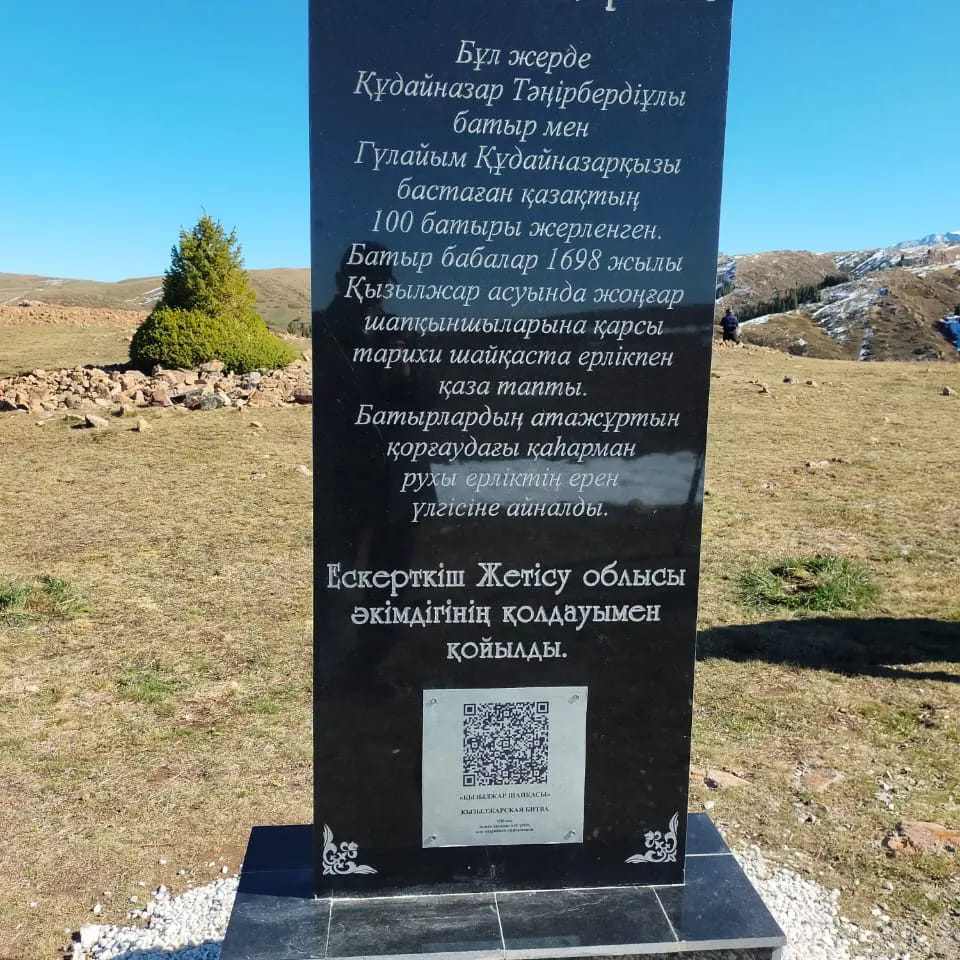
The expedition visited the historical site known by local residents as «Zhüz Oba» (One Hundred Burial Mounds) and «Qyz Beyiti» (The Girl’s Grave), as well as the mountain pass where the Kyzylzhar Battle is believed to have taken place. The participants of the expedition installed commemorative markers at the burial site of the batyr, his daughter, and the one hundred warriors, as well as at the site of the presumed battle, thereby bringing renewed attention to this forgotten page of history.
Ultimately, the Kyzylzhar Battle should be regarded as a continuation of the great battles fought in defense of the homeland during the late 17th and early 18th centuries. To date, the names of only two of the one hundred warriors who died in the battle are known, It is presumed that the remaining 98 warriors were members of four clans associated with the Tolegetai lineage – Zhalayir, Alban, Suan, and Dulat – whose people inhabited this region at the time.
Determining the historical truth behind this assumption remains a task for future research. Indeed, whenever we speak of defending the homeland, we most often commemorate the deeds of men, glorifying the courage of those who, as the famous Kazakh poetic expression says, «took up their spears and traversed their native land.»Yet this raises an important question : Why is the contribution of Kazakh girls and women to the history of our nation not given greater recognition?
Why do we not make greater efforts to preserve the names of the mothers and sisters who gave birth to batyrs and poets, helped govern their people through wisdom, and drove enemies away through their courage?
If we turn to historical sources and shezhire, we find that from the ancient Saka queen Tomyris to the heroines of modern Kazakhstan, Aliya and Manshuk, the history of the Kazakh people contains numerous examples of courageous women who defended their homeland.
Today, unfortunately, the heroic deed of Gulaiym Kudaіnazarqyzy remains insufficiently known. Knowing that she was facing certain death, she nevertheless risked her life to defend her people and her father. Her courage deserves to be remembered alongside the heroic deeds of the brave daughters of the Kazakh people.
Legend and Oral Tradition
Naturally, in seeking to establish the truth behind an event preserved in the form of a legend, the testimony of local residents was of considerable importance. Researchers turned to oral traditions passed down from generation to generation, the writings of historians and experts in shezhire, as well as poetic works by Kazakh poets and writers. Among these sources, particular importance is attached to the dastan «Yesengeldi Bi» by Dosber Saurykuly, created during the first half of the 20th century.
Suddenly, the Dzungars attacked the Kazakh land,
Finding an opportunity to strike and conquer.
Gathering their armed forces and troops,
They drove away the livestock and drew their bows.
The cauldrons were filled with fermented mare’s milk,
Dried curd lay spread out upon the racks.
Sheep bleated, camels groaned as the people fled,
And in the abandoned villages, only the dogs were left to howl.
Faced with this unexpected danger, the villagers reached the following decision:
Unable to withstand the war, the people grew frightened,
They formed a fighting force and followed behind the migrating people.
Taking away the women, children, and elderly,
Many young men remained behind to protect them.
The frightened Kazakh people retreated,
Seeking to pass through a narrow mountain pass.
Once the people had crossed beyond the pass,
The batyrs decided to lie in wait for the enemy.
To destroy the enemy at the mountain pass,
They gathered together and devised a plan.
To meet the enemy in the narrow passage and fight,
They summoned all their strength and courage.
At the exit of the pass, one hundred warriors led by Kudaіnazar Batyr fought the numerous Dzungar army for two days and two nights, battling like lions and preventing the enemy from passing through the gorge. But the enemy greatly outnumbered them, and the situation became increasingly difficult. Frustrated at being unable to defeat such a small force, the Dzungars repeatedly called in reinforcements, giving the warriors no opportunity to rest or replenish their weapons and ammunition.
One warrior after another fell. Eventually, an arrow struck Kudaіnazar’s horse, Tarazban.
In the end, only the batyr and his daughter remained. They gathered the arrows of their fallen comrades and, having nowhere else to hide, took shelter behind the body of Tarazban, continuing to shoot at the enemy. Whenever enemy arrows struck the body of the fallen horse, they pulled them out and used them against the enemy. Eventually, their arrows ran out, and father and daughter died heroically.
The dastan «Yesengeldi» describes the event as follows:
Thus they continued to shoot at the enemy,
Taking shelter behind the chest of the fallen horse.
One would shoot while the other supplied the arrows,
Preventing the enemy from advancing up the slope.
Looking out from their shelter around midday,
They saw that fifteen enemies had already fallen.
They continued shooting until evening,
But by then their arrows had run out.
Enraged because they could not defeat the two,
The enemies grew furious at their losses.
Like a dense forest, they surrounded them from every side
When they saw that the defenders had run out of weapons.
They captured the two alive and put them to death,
Showing no mercy once they had fallen into their hands.
Some time after these events, people who had moved ahead with the migrating community decided to return to the mountain pass to learn the fate of those who had remained behind.
They were met by a horrifying sight: the bodies of the fallen warriors, pierced by spears and arrows, lay scattered across the ground, becoming prey for ravens and other scavengers.
Since the Dzungars had burned the bodies of the dead, it was extremely difficult to determine their identities. Only by Kudaіnazar Batyr’s two front teeth and Gulaiym’s carefully braided hair were the father and daughter identified among the dead. The returning villagers dug a separate grave for each of the fallen, buried them according to tradition, and placed stones over the graves, forming oba – traditional burial mounds made of stones or earth.
According to the accounts of those who witnessed the aftermath, these stone burial sites at the mountain pass subsequently became known as «Zhüz Oba» (One Hundred Burial Mounds) and «Qyz Beyiti» (The Girl’s Grave).
Glossary
Oba (оба) – a traditional burial mound or cairn found across the steppe regions of Central Asia.
Dastan (дастан) – a traditional epic or narrative poem, usually telling stories of heroes, battles, love, historical events, or legendary figures.
Shezhire (шежіре) – the traditional genealogical and historical records of Kazakh clans and families.
Aul (ауыл) – a traditional Kazakh rural settlement or village.
Batyr (батыр) – a traditional Turkic and Kazakh title meaning a brave warrior, hero, or military leader.
Saba (саба) – a traditional large leather container used by Kazakhs to store and ferment mare’s milk, particularly kymyz.
Author: Kazhet Andas
Translated by: Amina Akylbek
Information Agency “Q-Andas”.
(To be continued…)