Посмотреть эту публикацию в Instagram
The value of a book is sometimes measured not by its length, but by the thoughts it leaves with the reader. One work may evoke the past, while another urges us to look critically at society today. And in certain books, a poet’s sensitivity, a journalist’s keen observation, a writer’s creative vision, and a citizen’s concern for the fate of the nation all converge. *Six-Line Verse*, a collection by the poet, journalist, and writer Kazhet Andas, is one such multifaceted work.
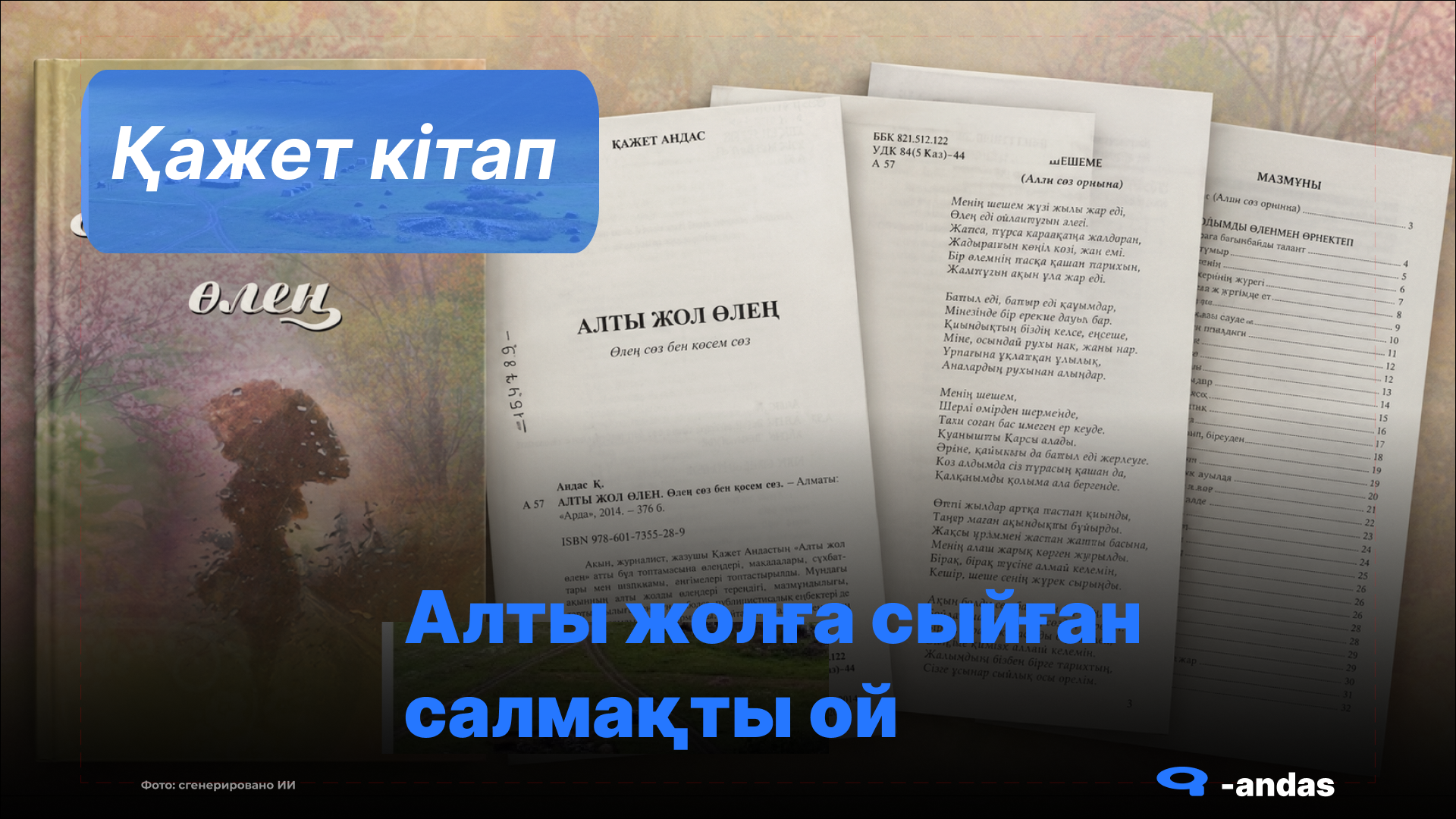
The book was published in 2014 by the Arda publishing house in Almaty. It comprises 376 pages and had a print run of 500 copies. The collection was published with the support of Amandyk Gabbasuly Batalov, then Akim of Almaty Region. The “six lines” in the title reveal the author’s creative quest to contain profound meaning within a concise form. The description on the cover – “poetry and publicistic prose” – precisely captures the nature of the collection, in which poetry and journalism, articles and interviews, stories and reflections unfold side by side.
The collection consists of eight sections: “Weaving My Thoughts into Verse,” “A Matter of Honour,” “Wisdom,” “The Stage,” “Between the Two of Us,” “Before a Thought Dies Within,” “In Its Original Form,” and “Improvisation.” The titles alone convey the book’s artistic and thematic breadth. In the first section, the author gives poetic form to his thoughts; in the chapters that follow, he offers journalistic reflections on issues of national importance, considers the work of figures from the arts and literature, interviews people from various professions, and transforms real-life events into literary stories.
Six Lines – Profound Meaning in Few Words
Although Kazhet Andas’s six-line poems are brief in outward form, they carry considerable inner weight. In every stanza, the poet seeks to contain a complete thought, a lesson drawn from life, or a social concern. Writing such verse requires an economy of words, a focused expression of thought, and the ability to entrust every line with a distinct semantic purpose.
The poems in the collection span a broad thematic range. The author dedicates verses to Ilyas Zhansugurov, Zhumatai Zhakypbayev, Nurgisa Tlendiyev, and other eminent figures who made an immeasurable contribution to the nation’s spiritual life. He portrays their creative identity not merely through the fate of an individual, but in connection with the spiritual life of the people as a whole. In “Talent Knows No Borders,” the legacy of Ilyas Zhansugurov reveals that genuine art is independent of time and space. “A Remarkable Life,” dedicated to Zhumatai Zhakypbayev, honours the poet’s delicate lyricism and love for his native land.
It would be insufficient to regard these works merely as poems of praise dedicated to celebrated individuals. By holding up the lives of prominent figures as examples, the author brings to the fore respect for talent, reverence for spiritual heritage, and service to the nation. In his view, an artist’s life does not remain confined to the private sphere. A genuine work becomes part of the people’s spiritual wealth and guides the generations that follow.
The poet’s works devoted to his mother tongue also merit special attention. In poems such as “My Language” and “My Mother Tongue Is My Wealth,” language is valued not simply as a means of communication, but as the foundation of national memory, historical continuity, and a people’s identity. Though concerned about the place of the mother tongue in society, the author does not confine himself to empty slogans. He makes it clear that respect for one’s language begins with understanding one’s own history, origins, and national values.
Poems such as “The Heart of the Kazakh Land” and “The Constitution Is My Pride” express respect for independence, faith in statehood, and reflections on national unity. The author reminds us that freedom did not come of its own accord: behind it lie the people’s struggle, endurance, and dreams. He therefore concludes that taking pride in independence is not enough; it must be strengthened through knowledge, honest labour, and civic responsibility.
A Writer Who Places Honour and Humanity Above All
One of the book’s central values is honour. It is no coincidence that the collection’s second section is entitled “A Matter of Honour.” For the author, honour is an inner compass that keeps a person from going astray, while integrity is the chief pillar that sustains society. His poems and articles criticise falseness, sycophancy, greed, indifference, and spiritual weakness.
The writer does not merely observe society’s shortcomings from a distance. He seeks the connection between every problem and a person’s inner world. He shows that the underlying causes of injustice in society, misunderstanding within families, distrust between people, and emotional distress arise from a weakening of one’s responsibility before one’s own conscience.
There is also profound moral significance in placing the poem “To My Mother” on the opening page of the book “In Place of a Foreword.” The author connects his path as a poet with his mother’s upbringing and spirit. Here, the image of the mother is not merely that of one family’s parent, but a symbol of the great formative power that instils courage, resilience, compassion, and humanity in future generations. The poem seems to establish the collection’s overall spiritual direction. At the source of the writer’s attitude towards his nation, his land, and humanity lie family upbringing and a mother’s example.
The author also reflects on happiness, friendship, loneliness, regret, love, faith, and the transience of life. Poems such as “Friendship,” “My Other Half,” “I Am Alive,” “Faith,” and “Happiness” reveal different facets of human feeling. In them, we encounter a lyrical persona who has known both life’s joys and sorrows, has come to understand human character, and yet has never lost hope for better days.
In this respect, *Six-Line Verse* is not merely the author’s reflection on the outer world, but also a chronicle of his inner life. The poet does not conceal his state of mind. At times he grieves, at times he questions society, and at times he turns his gaze upon his own character. Yet under all circumstances, he retains hope and faith in his country.
A Commitment to the National Heritage
The preservation of national heritage is an important theme running through the collection’s journalistic articles. The pieces in “A Matter of Honour” address Kazakh song, dance, literature, historical heritage, and cultural values. The author regards mere pride in national culture as insufficient. In his view, a cultural treasure must be preserved, studied, promoted, and practised in everyday life.
In the article “We Have No Shortage of Songs and Singers…,” the writer considers the place of Kazakh song in society and draws attention to the scarcity of Kazakh-language works portraying particular occupations and modern professions. He connects this issue with the domains in which the language is used. Language should live not only on official platforms or at festive events, but also in science, technology, industry, professional settings, and everyday work.
The article “If It Were Not for ‘Kara Zhorga’…” raises the question of responsibility for one’s own national heritage. Before blaming others, the author calls attention to how well Kazakh society itself recognises, values, and develops the treasures in its possession. He reminds us that national art must not merely survive in the people’s historical memory; it must be protected through the conscious actions of the present generation.
These reflections have lost none of their relevance today. In an age of globalisation, preserving national heritage cannot be reduced to jealously guarding it from others. It must be studied scientifically, substantiated with reliable evidence, communicated to younger generations in accessible language, and presented to the world at a fitting standard. From this perspective, the book’s journalistic articles may be read as a civic voice calling the reader to action.
The Central Subject of Journalism Is the Human Being
Kazhet Andas’s journalistic principles are clearly visible in the interviews and articles included in the book. Rather than leaving social phenomena at the level of general facts and official information, the author seeks to reveal their effects on human lives. He addresses diverse subjects, including art, culture, health, upbringing, social conditions, and emotional distress.
The section “Between the Two of Us” uses the interview genre to present the experience and views of specialists from various fields. When asking questions, the journalist does not remain merely a collector of information. He searches for the causes of a problem and strives to find the answer society needs. Throughout these interviews, professional experience and human destiny are closely intertwined.
In conversations about nervous disorders, social understanding, and the human inner world, the writer suggests that a person suffering from illness should not be set apart from society. He argues that family difficulties, social pressure, loneliness, and a lack of understanding can all affect a person’s emotional well-being. The lesson of these pieces lies in their call not to judge people by outward appearances, but to strive to understand their inner world.
The author does not attempt to portray his characters as flawless. He does not conceal the contradictions, regrets, and painful moments in their lives. Yet his compassion for the human being never disappears. This is the quality that unites the book’s stories, interviews, and journalistic articles.
Respect for History, Responsibility for the Future
The theme of history recurs throughout the book. Time and again, the author returns to historical figures, periods endured by the nation, the people’s heritage, and the sacred nature of the native land. Yet his purpose in recounting the past is not simply to recall old events. He searches history for the lesson it can offer today’s generation.
In the writer’s understanding, history is not a ready-made tale for pride, but a legacy that entails responsibility. Recounting the courage and wisdom of the ancestors must not cause the present generation to forget its own duty. On the contrary, the example of the past should become the measure of action today.
In works such as “A Sacred Land – A Country Rich in Saints,” the nature and sanctity of the native land are intertwined with spiritual ideas. Land is not merely a place to live; it bears the footprints of the ancestors, the memory of the people, and the future of coming generations. Love for one’s homeland is therefore demonstrated not only by praising it in words, but by learning its history, protecting its natural environment, and serving the good of the nation.
The Unity of Poetry and Publicistic Prose
The collection’s defining feature is the natural harmony achieved by different genres within a single book. At first glance, poetry, articles, interviews, and short stories each possess a distinct artistic nature. Yet they are united by the author’s worldview and civic principles.
Questions of language, nation, honour, humanity, and historical memory raised in the poems are explored at greater length in the journalistic articles. The interviews add the views and lived experience of specialists, while the stories portray social phenomena through individual destinies. In this way, each genre in the book complements the others.
Poetry moves the reader’s emotions, while journalism invites reflection. An interview foregrounds concrete experience; a story enables the reader to feel the truth of life through a character’s fate. This structure shows that Kazhet Andas is not confined to a single creative direction. He is a poet who entrusts his innermost thoughts to verse, a journalist who examines social issues, and a writer who gives artistic form to human life.
The Book’s Educational and Moral Value
Rather than offering ready-made answers, *Six-Line Verse* asks the reader essential questions: How deeply do we appreciate our mother tongue? What are we contributing to the preservation of our national heritage? Do we recognise the responsibilities that come with independence? Are we judging people merely by their outward circumstances? What place do honour and integrity hold in society? Are we learning from history?
The book’s educational value lies in its interconnected treatment of literature, art, history, culture, and social issues. Its moral significance lies in calling readers towards humanity, respect for their mother tongue, faithful service to their country, appreciation of the past, and responsibility for the future.
Although some time has passed since the collection was published, the issues it raises have lost none of their relevance. The sphere of language use, preservation of national heritage, spiritual values, human destiny, the social role of art, and civic responsibility remain vital concerns today. This enables the book to resist the passage of time and meet each new generation of readers anew.
*Six-Line Verse* is a work that brings together a particular stage in Kazhet Andas’s creative journey. At the same time, it presents a coherent vision of the writer’s reflections on nation and land, language and history, art and human destiny. The author contains great meaning within six lines of verse and uses publicistic prose to probe the depths of social issues.
In this book, we encounter at once the poet’s sensitivity, the journalist’s alert gaze, the writer’s compassion for the human being, and the citizen’s responsibility before his country. *Six-Line Verse* is therefore not merely a book to be read, but one whose ideas deserve to be taken to heart and whose lessons deserve to be learned. Herein lies its greatest value.
BBK 821.512.122
UDC 84 (5Kaz)-44
A57
Almaty: Arda, 2014. – 376 pages.
ISBN 978-601-7355-28-9
https://kazneb.kz/kk/catalogue/view/1524861
Article by:
Aisulu Bauyrzhankyzy.
Video filmed by Amina Sayahatkyzy.
Correspondents of the Q-Andas News Agency.