THE TEZEK TORE FAMILY BURIAL SITE – 19TH CENTURY
Location: Zhetisu Region, Kerbulak District, Altynemel Rural District, Makpal area.
Research: Researchers – Azamat Akylbekov and Bagdat Akylbekov. The site was studied during an expedition organized by the Kazakh National University in 2021.
Article: “Tezek Tore Korymy”
Description
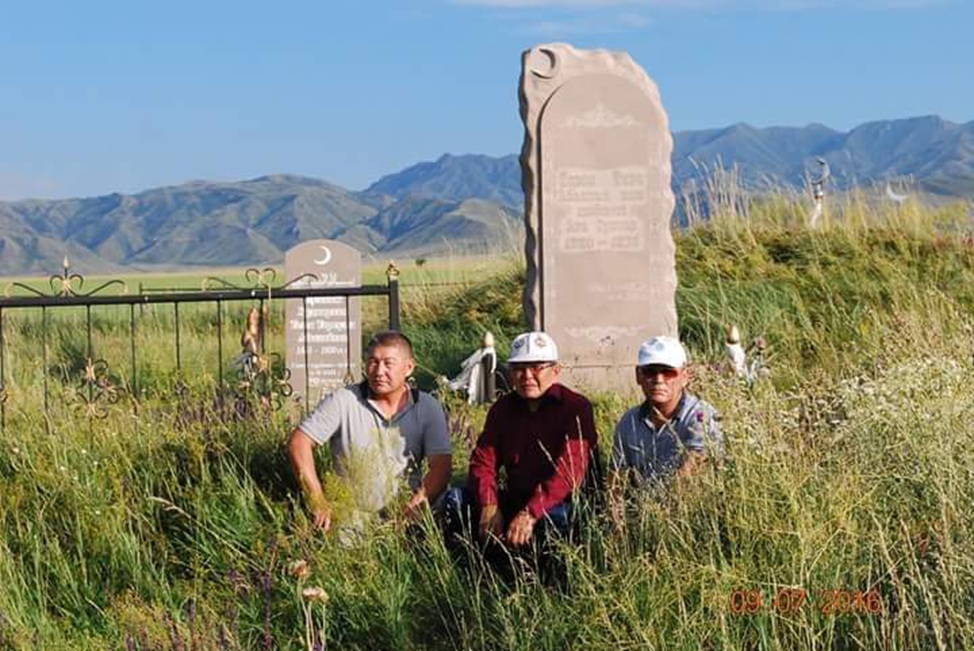
About 40 kilometers from the Saryozek-Zharkent highway, after turning right and driving another 4-5 kilometers, there is a small village now known as Karlygash. The family burial site of Tezek Tore Nuruly, a well-known sultan of Zhetisu, is located here.
The area, situated at the foot of the famous Altynemel Pass in Kerbulak District of Zhetisu Region, has been known as Makpal for generations. The memory of this sacred place has been passed down from one generation to another, and many local residents can still point out its location. The burial site of Tezek Tore is also marked on military maps from the period of the Russian Empire that have survived to this day.
In early July 2021, as part of preparations for the international conference “Tezek Tore – 200”, a research and educational expedition was organized here by Academician N. Kapalbekuly. Together with scholars who arrived from Almaty and Nur-Sultan, the researchers carried out measurements of the site and examined the surviving features of the burial complex.
Like many burial sites belonging to members of the sultan’s lineage, the area was enclosed by a wall made of locally available materials – brick, adobe and stone. The wall was approximately 2 meters high, 20 meters long and 15 meters wide. The total area of the burial site was about 300 square meters.
Inside the enclosure, a raised structure has survived – the remains of a mausoleum. Judging from the surviving foundation, a large dome once stood here. According to oral traditions passed down through generations, the grave of Tezek Tore was located beneath this dome.
Aware that the pressure of the Russian Empire was growing and that its colonial policy was becoming increasingly harsh, Tezek Tore ordered the site to be enclosed by a wall during his lifetime. He also ordered a tall and richly decorated dome to be built over the place where he would later be buried.
The famous Naiman poet Tubek commemorated the dome in the following words:
“Shagan Bugydan korindi kok kumbezin…”
– “Your blue dome could be seen from Shagan Bugu…”
In July 1879, Tezek Tore died and, according to his wishes, was buried beneath the dome he had ordered to be built during his lifetime.
His memory was also preserved in the poetic heritage of the period. Suinbay Aronuly, one of the prominent akyns of the 19th century, dedicated works to Tezek Tore, expressing grief over his death and reflecting the respect people had for their contemporary.
Research has established that the diameter of the surviving part of the foundation on which the dome once stood was approximately 8-10 meters.
Why Was Tezek Tore Buried Here?
A question sometimes arises: why was Tezek Tore not buried at Koshen Togan Cemetery, where the great scholar Shokan Ualikhanov is buried, since the two places are relatively close to one another?
One possible explanation is connected with the history of his family.
The name of Tezek Tore’s father, Nuraly, does not appear in some records from 1825. This may indicate that he had died earlier. This assumption is also consistent with an oral tradition stating that “our khan’s son was left an orphan at the age of five.”
For this reason, there is a theory that Sultan Nuraly Adiluly Abylaikhanov was originally buried here. He is believed to have been born around 1790 and to have died around 1825.
Later, in 1860, a severe smallpox epidemic spread throughout Zhetisu. During the epidemic, Tezek Tore’s mother, who was approximately 55-60 years old, and his brother Sherali, who was about 35-40 years old, died. Sherali’s name has not been preserved in oral shezhire (genealogical traditions), although it appears in historical documents.
During the same period, Tezek Tore’s 12-year-old son Saduakas and his younger son Saniyaz also died. At Tezek Tore’s request, they were all buried here.
These events are believed to be connected with oral accounts stating that Suinbay and other akyns came to offer their condolences to Tezek Tore. Other close relatives were also later buried here.
Over time, the site thus became a large family and ancestral burial ground belonging to Tezek Tore’s family. For this reason, the sultan ordered the area to be enclosed by a wall and a dome to be built inside for his future burial.
Destruction of the Burial Site
Unfortunately, the burial complex was later damaged during the colonial settlement of the region. According to local oral traditions, settlers who arrived in the Altynemel area dismantled the enclosure and the dome and used the bricks to build their own houses.
According to these accounts, local Kazakhs attempted to prevent the destruction of the sacred site but were unable to stop the settlers.
Soon afterward, an earthquake struck the area. According to the legend, the settlers’ houses were completely destroyed, and around 16-17 people were killed beneath the ruins.
When the Kazakhs learned what had happened, people from surrounding villages gathered at the burial site. Angered by the destruction of the sacred place, they reportedly said:
“You have desecrated the spirit of our khan. He was a man of exceptional holiness. Allah has punished you for this.”
The remaining settlers were overcome with fear. According to the oral tradition, they returned the bricks left from the construction work to the burial site and piled them there.
Over time, moisture, wind and sunlight caused the bricks to deteriorate, leaving only a heap of broken fragments. According to local accounts, these remains can still be seen at the site today.
If the numerous graves, the enclosure and the dome had survived in their original form, the complex could today be of considerable historical and architectural value. It could serve as an important monument reflecting the architectural heritage of the Kazakh people in the 19th century.
It is particularly significant that, according to surviving accounts, the complex was not destroyed solely by the passage of time or natural forces, but was also deliberately dismantled by people. This raises the question of whether the historical site could be restored in accordance with its original appearance.
If the state gives due attention to the Tezek Tore family burial site and restores its enclosure and dome, this would make an important contribution to the preservation of the historical and cultural heritage of Zhetisu.
In the future, tourist infrastructure could also be developed nearby, including a parking area, a small park, a café or dining facility, accommodation and sanitary facilities. With appropriate promotion, the site could become an attractive destination for visitors from different regions of Kazakhstan and from abroad.
The burial place of Shokan Ualikhanov also deserves similar attention, according to researchers.In addition, the ancient ditch known locally as “Zhoshy Ory” or “Zhoshy Arany” could be developed as an open-air museum. According to local accounts, the ditch was created more than 700 years ago and stretches for approximately 60 kilometers. One of its sections is located near the highway.
Together, these sites could form part of a historical and cultural route connecting several important heritage sites of Zhetisu.
The Dome of Tezek Tore
Tezek Tore enclosed the place where his father, mother and brother had been buried, gradually turning it into a large family burial ground. Later, his wives and other members of the family were also buried here.
Around 1875, Tezek Tore ordered a large dome to be built over the place where he would eventually be buried. According to oral accounts, it was a magnificent and richly decorated structure.
The famous Naiman poet Tubek described it in the following words:
“Your blue dome could be seen from Shagan Bugu…”According to local traditions, the dome was visible from a considerable distance and stood out against the surrounding landscape. Unfortunately, in the 1920s, the dome was dismantled and its bricks were used to construct houses. According to a local legend, after the settlers had completed the construction and moved into their new homes, disaster struck. The houses suddenly collapsed, killing 16-17 people, including women and children. After this, the settlers reportedly called the place a “cursed grave” and returned the remaining bricks to the burial site, piling them there. Thus, over time, all that remained of the once magnificent structure was a heap of broken bricks.
LEGEND: HOW TEZEK TORE SETTLED LAND BOUNDARIES
In earlier times, disputes over land and widows were common. Rivalry between clans and villages sometimes led to barymta – the traditional practice of taking livestock or property from another group as a form of compensation or retaliation. Such disputes could also develop into armed conflicts and long-lasting hostility.
According to legend, Tezek Tore, who placed justice and unity above all else, used an unusual method to reconcile opposing sides. He ordered two young boys from the rival groups to mount fast horses and ride from their respective villages toward one another. When the boys met, they were stopped and made to dismount. In the presence of the elders of both sides, Tezek Tore told them:
“Embrace one another. From now on, you are brothers.”
He then addressed the people gathered there:
“A child is an angel. Do as these children have done and become brothers. From now on, this place shall be the boundary between your lands. If you continue to quarrel and fight after this, you will have to answer to me.”
According to the legend, his words were enough to put an end to long-standing disputes.
People who respected Tezek Tore for his sense of justice and wisdom reconciled with one another, established family ties and gradually forgot their former conflicts.
THE STORY OF THE STALLION
Tezek Tore had a contemporary who was a wealthy but notoriously stingy man. He was not particularly well-liked among the people.
One day, Tezek Tore’s men noticed an extraordinary stallion among his horses. Knowing how valuable the animal was, they decided both to tease the wealthy man and to test him.
They said:
“Baieke, such a stallion does not belong in your herd. A horse like this would be more worthy of a Tore. Why don’t you give him to Tezek Tore?”
The wealthy man replied:
“Do not say such things. This stallion is the sacred force of my livestock – the sacred force and blessing believed to protect and sustain the herd. Even if you take half of my herd, do not touch this horse.”
When Tezek Tore heard what the man had said, he told his people:
“Ah, you tricksters! You deliberately said that, knowing how stingy he is. Why did you have to do this? Now the animal will suffer because of your words. After what you have said, such a fine horse can no longer remain with him. You should not have said it. This stallion will not live to see the morning.” And so it happened. The following day, the stallion was found dead.
ABOUT THE URSHIK
One day, Tezek Tore saw his daughter-in-law spinning yarn using an urshik, a traditional spinning device.
He looked at her and said:
“Hey, zhengei, this world is like the spindle turning in your hands. Sometimes it spins without stopping, and sometimes it comes to a halt. The thread, too, sometimes remains unbroken, and sometimes suddenly snaps. Just think what a remarkable thing you hold in your hands…”According to the tradition, through these words Tezek Tore compared human life to the turning of a spindle and a thread that can break at any moment.
THE LAST DAYS OF TEZEK TORE
- Zheksenbinov, Taldykorgan
We heard these stories from our ancestors.Our ancestors were respected members of the Zhalaiyr clan. They lived on the southern side of Shagan, in an area that had been designated for them by Tezek Tore.
Our people always maintained good relations with the Tore family. They exchanged goods, stayed in contact and supported one another. My father’s grandfather was a contemporary of Tezek Tore. He was a well-known healer and was highly respected by the people.
One day, urgent news reached the village that Tezek Tore was seriously ill.Our ancestor, together with several other respected men, went to find out about his condition. When they arrived, Tore was indeed bedridden and unable to get up. Many respected people from different parts of Zhetisu had gathered around him.Our ancestor was a healer. He gave Tezek Tore medicines prepared from various medicinal herbs that he had brought with him. After treating his hands and legs for some time, Tore was able to get up, sit supported by pillows and greet those who had arrived. He then looked at our ancestor and said:
“Hey, Yelibai, I feel a little better after your treatment. You must be an unusual man. Tell me, how much longer do I have to live?”
Our ancestor replied:
“Aldiyar, why should I hide the truth from you? Does this world not come to an end for every one of us? You have seven days left. You should begin preparing yourself.”
Tezek Tore then looked at his jigit – a trusted companion or warrior – and said:
“What is this worthless Zhalaiyr saying? Bring me my sword. I will show him myself what should be done three days before my death.”
The household members became frightened and tried to defend the healer:
“Khan iem, perhaps he made a mistake when he said seven days. You will live for many more years. Seven is a sacred number among the Kazakhs. Perhaps that is what he meant.”
Tore then looked at our ancestor again and asked:
“Well, Yelibai, what do you say now? How many days do I have left?”
The healer replied:
“Taqsyr, you are the support of the entire people. I cannot lie to you.”
Tezek Tore smiled and said:
“I only wanted to see what you would say. I can feel it myself.”
After that, according to the tradition, he addressed those around him and left them his final words:
“When I am gone, do not let your unity disappear with me. When I die, do you really think that among our Kazakh people there will not be born another son like me, or even greater than me? Do not lose heart. Above all, remain united. Never think only of yourselves; think of the well-being of the people.”
With these words, according to the oral tradition, Tezek Tore said farewell to those around him.
PUBLISHED MATERIALS
“Tezek Tore.” 2013. A. Akylbekov.
“Anthology of Zhyr and Aitys Dedicated to Tezek Tore.” 2014. A. Akylbekov.
“Tezek Tore – 200.” 2021. Compiled by A. Akylbekov.
Research books and collections devoted to the life, activities and historical heritage of Tezek Tore have also been published, including collections of zhyrs (poetic works) and aitys (traditional poetic contests between akyns).
Kazakh Cultural Terms Glossary
Tore – a title and social status traditionally associated with the descendants of Genghis Khan. Members of the Tore lineage historically held positions of authority among the Kazakh people.
Sultan – a traditional title used for members of the Tore lineage who held political or administrative authority.
Aul – a traditional Kazakh settlement or village, historically consisting of several families or clans.
Akin – a traditional Kazakh poet, singer and oral performer, often known for improvising poetry.
Zhyr – a traditional Kazakh epic or poetic work, usually performed orally by an akyn or zhyrshy.
Aitys – a traditional poetic contest in which two akyns improvise verses in response to each other.
Shezhire – an oral or written genealogy preserving the history and ancestry of a family, clan or tribe.
Barymta – a traditional practice of taking livestock from another group, historically associated with disputes, retaliation or claims for compensation.
Jigit – a young man traditionally associated with horsemanship, courage and service; in historical contexts, a trusted companion or warrior.
Zhengei – a respectful Kazakh term used by a younger relative when addressing or referring to an elder brother’s wife or a similar female relative by marriage.
Taqsyr – a respectful traditional form of address for a respected or influential man, roughly meaning “master” or “lord.”
Kie – a sacred or protective spiritual force believed to be connected with people, animals, places or nature.
Urshik – a traditional tool used for spinning wool or thread by hand.
Baike – a respectful form of address for an older or respected man, often used when speaking to a wealthy or influential person.
Khan iem – a respectful form of address meaning approximately “my khan,” reflecting traditional respect toward a ruler or senior leader.
Author: Kazhet Andas
Translated by Amina Sayahatqyzy,
Q-Andas Information Agency.
(To be continued…)