 ШӘКІЛ СОЛТАНГЕЛДІҰЛЫ
Soltankeldi Myrza was married three times. His first wife bore him seven sons: Kobes, Tabылды, Itkara, Karynбай, Samembet, Konysбай, and Turdygul. His second wife gave birth to one son, Kozhabaek. His third wife, our revered ancestress Zhap, had two sons, Maltabar and Shakil. Shakil was the younger of the two.
The sons of the first wife formed the larger and more influential branch of the family. As a result, Maltabar and Shakil, whose branch was smaller, were often treated as though their wishes mattered less. The family’s principal ancestral home, known in Kazakh tradition as the kara shanyrak, was therefore assigned to Turdygul, the youngest son of the first wife.
The kara shanyrak is more than a family dwelling. It represents the ancestral hearth, the continuity of the family line, and the responsibility of preserving a family’s heritage for future generations.
At the time, the warrior Maltabar was away from the village. When he returned, he discovered that the white yurt in which his younger brother Shakil had been living had been moved elsewhere. Outraged by this injustice, Maltabar took up his battle axe, one of the traditional weapons carried by a warrior, and resolved to set matters right.
He declared that, according to ancestral custom, the right to preserve the kara shanyrak of Soltankeldi Myrza belonged to Shakil, the younger son of his third wife. The elder brothers refused to accept his decision. They apparently believed that, because Maltabar and Shakil represented a smaller branch of the family, they could be pushed aside.
When his brothers refused to acknowledge his claim or agree to what he considered the rightful arrangement, Maltabar lost patience and took action. He raised his axe and split the main crossbeam above the entrance and the threshold of the ancestral house, dividing each down the middle. He left one half with Turdygul and took the other half away.
He then moved the house and re-erected it for Shakil. The elder brothers did not dare interfere. Unable to challenge Maltabar, they had no choice but to accept what he had done.This episode came to be remembered as an expression of Maltabar’s honesty, courage, determination, and deep understanding of ancestral law and custom.
Maltabar was devoted to his only younger brother. He never suppressed Shakil’s wishes or treated him harshly. Instead, he cared for him, encouraged him, and raised him with generosity and affection.
One day, Maltabar asked his younger brother:
«What does your heart truly desire? What would you like to do? What is your greatest interest?»
Shakil replied:
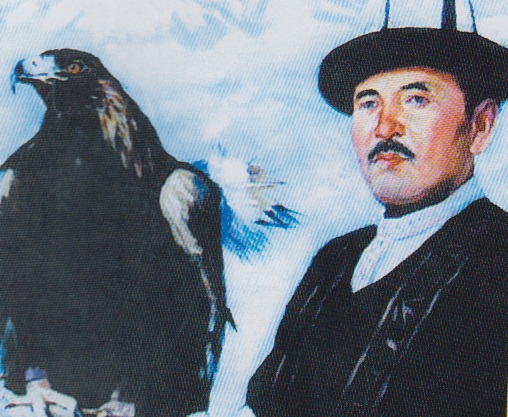
«I love sayatshylyk – hunting with birds of prey. I want to become a kusbegi, a traditional Kazakh falconer who trains and cares for hunting birds.»
As Maltabar travelled through the land and visited different villages, he came across three eagles in a settlement belonging to the Karakerei clan. The birds were perched on stands, each with its eyes covered by a traditional leather hood known as a tomaga. Such hoods help keep hunting birds calm until they are ready to fly.
Maltabar asked his younger brother:
«Which of these three eagles would you choose?»
Shakil had been fascinated by birds of prey since childhood and liked to watch them closely. After studying the three birds, he chose the one perched in the middle. It had golden-yellow feathers across its belly, a prominent brow, blood-red eyes, and an intense, piercing gaze. It was a powerful young hunting bird, described in the original account as a muzbalak – a term associated with a particularly formidable young bird of prey prized for its strength and hunting ability.
Determined to fulfil his brother’s wish, Maltabar paid fourteen horses for the eagle – an entire breeding herd of mares.
Ancestor Shakil devoted himself to the bird and trained it with exceptional care. For nine years, he worked with his powerful eagle, taking it out to hunt and refining its abilities.
According to the family tradition, the eagle proved capable of bringing down an extraordinary range of game. Its quarry included bears, wolves, deer and red deer, argali sheep and mountain goats, and foxes. In the telling of the story, the bird could take almost any four-legged animal it was sent after.
Thus, the story of Ancestor Shakil has endured through generations: the story of a man whose passion for hunting with eagles was made possible by the generosity of his elder brother Maltabar. Their story preserves not only the memory of an exceptional hunting bird, but also the values of family loyalty, courage, justice, and respect for ancestral tradition.
Author: Kazhet Andas
Translated by: Amina Sayahatkyzy
Q-Andas News Agency
(To be continued…)