Қазақша: https://qandas.kz/%d2%9byzaj-t%d2%afskiiz-2764/
From ancient times to the present day, the Kazakh people have carefully passed down their rich cultural heritage from generation to generation and from father to son. This heritage took shape across the vast lands of the Great Steppe, the cradle of the «Steppe Civilization.» Thanks to its unique history and distinctive traditional arts and crafts, Kazakh culture has become known far beyond the borders of the country.
The Kazakh people are the direct heirs to an ancient culture that developed on the territory of present-day Kazakhstan over many centuries. They have not only preserved the traditions and customs of their ancestors but have also continued to develop, renew and enrich them.Hospitality has always held a special place in Kazakh culture. In a traditional dwelling, a separate area was usually set aside for honoured guests, and it was decorated with particular care. The walls were adorned with various decorative items, among which «tuskiiz» — a traditional Kazakh felt wall hanging — held a special place. These pieces were carefully made and intricately decorated by Kazakh craftswomen.
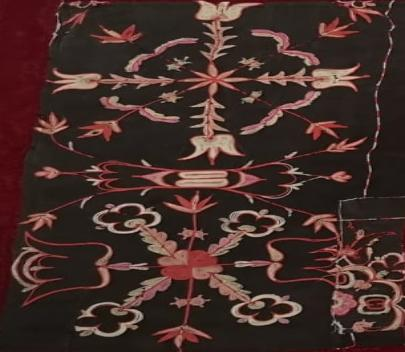
Tuskiiz were traditionally made of felt and decorated with white, black and red ornaments. Most often, they were rectangular and large enough to cover the wall space between the kerege, the lattice framework of a traditional Kazakh yurt.
Tuskiiz served not only as a decorative element but also had a practical purpose. It helped protect the interior of the yurt from the cold that could enter through the kerege. For this reason, tuskiiz were made from thick felt and then richly decorated with expressive ornamental patterns, giving them both practical and artistic value.
The name «tuskiiz» is connected with the way the item was traditionally placed inside the dwelling. Such wall hangings were most often hung near the sleeping area, which is reflected in the name itself.The edges of a tuskiiz were usually finished with a single-coloured fabric, such as velvet, baika or woollen cloth, and decorated with embroidery made from colourful threads. The central part was covered with carefully selected fabrics, including silk, velvet and brocade. The piece was then backed with felt.Sometimes the entire surface of the white felt was decorated with appliqué ornaments in red, yellow and blue. There were also more luxurious versions, including tuskiiz made of red leather and embellished with silver.
The ornamental design of a tuskiiz usually formed a unified composition of carefully arranged traditional motifs. Among the most common were «мүйіз» (horns), «гүл» (flower), «жапырақ» (leaf), «шырмауық» (vining plant), «түйетабан» (camel’s foot), and «алқа» (pendant ornament). The patterns were embroidered with colourful threads and, in some cases, further decorated with pearls and coral.
It is difficult to determine the exact year when this particular tuskiiz was made. However, it is known to have belonged to the family of Zhansarbai Ultarakyuly. In 1946, when Zhansarbai Ultarakyuly passed away at the age of 95, the women of the village divided the tuskiiz into pieces according to a traditional custom. The fragment presented here is one of the surviving parts of that original piece.
According to art historians, the tuskiiz was made using silk threads of Chinese origin. Researchers believe that the silk was brought by merchants from inland China and sold in the Ili Valley and Tarbagatai region between 1850 and 1870.
Author: Kazhet Andas
Translated by Amina Akylbek,
Q-Andas Information Agency.
(To be continued…)