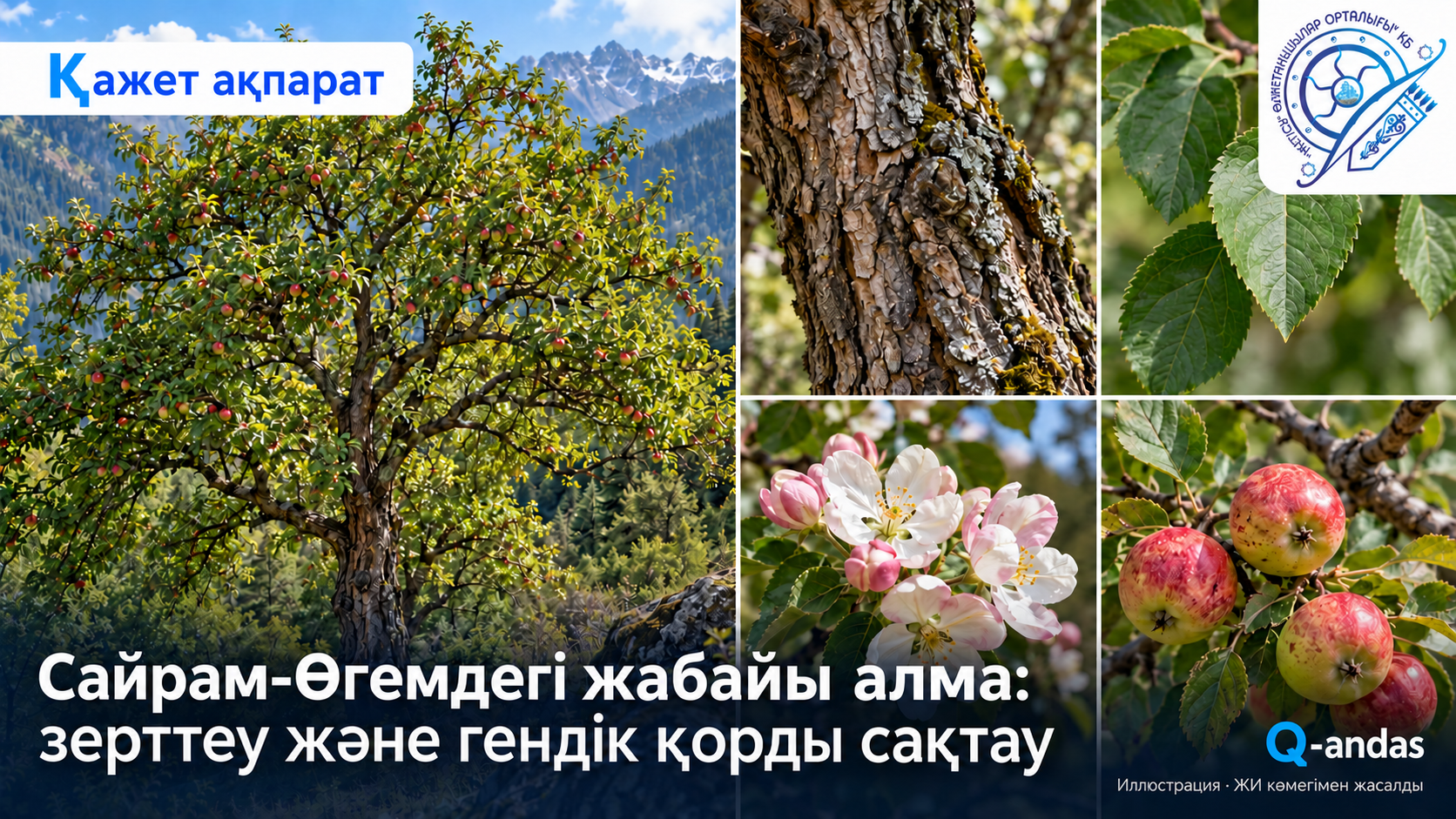
Abstract: This article examines the condition of wild apple trees, including the Sievers apple (Malus sieversii (Ledeb.) M. Roem.), in Sayram-Ugam State National Nature Park and the results of efforts to conserve and expand its genetic resources. Sievers apple seedlings planted in the Ugam and Bakshelpek forest districts were monitored through phenological observations and biometric measurements. The article presents survival rates for plantings established in 2007 and 2009, tree heights and trunk diameters, leaf measurements, and fruit characteristics. It also describes the adaptation of different Sievers apple clones and the results of seed collection. The findings indicate that clones brought from Almaty Region adapt slowly to conditions in the park. Laboratory analysis of 6 kg of seeds collected from previously selected valuable trees found a purity of 99% and viability of 64%. The seeds were assigned to the third quality class.
Keywords: Sievers apple, Malus sieversii, genetic resources, clone, seedling, phenological observation, biometric measurement, adaptation, nursery.
Introduction
Since Sayram-Ugam State National Nature Park was established in 2006, particular attention has been paid to conserving and expanding the genetic resources of the Sievers apple within the park. The species occurs in the Kokbulak, Daubaba, Ugam, Keles and Bakshelpek areas. Restoring, conserving and propagating wild fruit trees and shrubs is an important part of protecting biodiversity.
The Sievers apple displays considerable variation in form and is regarded as valuable genetic material for plant breeding. According to the original research materials, field studies examined the characteristics of its natural stands, growing conditions, distribution sites and areas suitable for collecting seeds.
Published sources indicate that human activity, changing growing conditions and a shrinking range affect the survival of natural Sievers apple populations. Natural events and changes, including mudflows, earthquakes and falling water levels in rivers and streams, also have an impact.
Aim and objectives
The study aimed to assess the condition of natural and planted Sievers apple stands in Sayram-Ugam National Park and describe the results of efforts to conserve and expand the species’ genetic resources.
Its objectives were to: 1) monitor the species’ natural distribution sites and growing conditions; 2) assess the growth and development of planted seedlings through observations of their seasonal growth stages; 3) measure tree height and trunk diameter; 4) compare how different clonal forms adapt; and 5) assess the potential for seed collection and determine seed quality.
Materials and methods
The study was conducted in natural Sievers apple stands within the park and in planted stands in its Ugam branch. The trees observed included seedlings planted in 2007 and 2009 and the clonal forms “Asya”, “Zailiyskoye Zelenoplodnoye”, “Zailiyskoye Sredneplodnoye”, “Dzhungarskoye Osenneplodnoye”, “Askar” and “Dzhungarskoye Letneye”.
The original material states that fruit yield was assessed on a six-point scale using methods developed by A. Zh. Dzhangaliyev, V. G. Kapper and A. N. Formozov. Diseases and pests were assessed using forest pathology methods, also on a six-point scale. The seedlings’ seasonal development was observed, and biometric measurements were taken.
The measurements included tree height; trunk diameter near the root collar and at the middle of the trunk; in some cases, the diameter of upper shoots; and leaf length and width. Several clonal forms were measured through selective sampling in July and August 2014.
Findings
In 2007, 1,400 Sievers apple seedlings were planted on 5 hectares in the Ugam branch, with 6 × 6 m spacing. Another 92 seedlings were planted on the same site in 2009 to fill gaps. The original document reports a first-year survival rate of 93% and a second-year figure of 70%. In 2009, 1,008 seedlings were planted on 4.5 hectares in Bakshelpek Forest District, also with 6 × 6 m spacing. To fill gaps there, another 400 seedlings were planted in 2011 and 600 in 2012. The reported figures for both the first and second years at this site were 90%.
The seedlings came from the Issyk forest nursery in Almaty Region. The planting stock comprised several clonal forms of the Sievers apple selected by Professor A. Dzhangaliyev.
Biometric measurements of the clones
Eight trees of the “Asya” clone were measured in 2014. Their heights ranged from 152 to 191 cm. Trunk diameter was 19–29 mm at the base and 11–20 mm at the middle, while the diameter of the upper shoots was 7–10 mm.
| Measurement | 1 | 2 | 3 | 4 | 5 | 6 | 7 | 8 |
|---|---|---|---|---|---|---|---|---|
| Tree height, cm | 185 | 191 | 168 | 178 | 189 | 156 | 152 | 186 |
| Trunk diameter at the base, mm | 29 | 28 | 22 | 27 | 29 | 20 | 19 | 28 |
| Trunk diameter at the middle, mm | 20 | 14 | 11.5 | 14 | 15 | 12 | 13 | 16 |
| Upper shoot diameter, mm | 9 | 10 | 8 | 9 | 8 | 10 | 7 | 9 |
In August 2014, trees of the Dzhungarian clone planted in 2009 were measured selectively. Their heights ranged from 165 to 299 cm, trunk diameters at the base from 21 to 43 mm, and trunk diameters at the middle from 11 to 32 mm. The tallest tree was 299 cm high, with a trunk diameter of 43 mm at the base and 32 mm at the middle.
In another set of measurements, trees of the “Asya” clone were 93–151 cm high. Their trunk diameters ranged from 7 to 28 mm at the base and from 5 to 32 mm at the middle. Some trees were developing well, while individual trees showed weak leaf growth or poor overall development.
Leaf and fruit measurements
Among the studied “Asya” trees, leaves measured 61–72 mm in length and 49–52 mm in width. On seedlings near the Hunters’ House, leaf length ranged from 78 to 93 mm and width from 48 to 57 mm.
The study also recorded biometric measurements for seven other “Asya” trees. Their heights ranged from 142 to 188 cm, trunk diameters at the base from 21.5 to 29 mm, and trunk diameters at the middle from 18 to 21.5 mm.
Trees in compartment 58, plot 28 of Bakshelpek Forest District were 143–259 cm high. Their trunk diameters were 25–43 mm at the base and 16–40 mm at the middle. A fruit on one of the fruiting trees measured 24 mm in height and 31 mm in width.
Seed collection and conservation of genetic resources
The Ugam branch collected 6 kg of seeds from previously identified superior Sievers apple trees. The seeds were tested at the Kazakh State Republican Tree Seed Institution in Almaty. The assessment placed them in the third quality class: their purity was 99% and viability 64%. The certificate was No. 433, dated 16 October 2014.
This result documents work to collect seed material from valuable wild trees and use it in efforts to conserve the species’ genetic resources.
Discussion
The findings show that the Sievers apple grows in natural stands within Sayram-Ugam National Park and is also cultivated in planted stands to conserve its genetic resources. Observations of seedlings planted in 2007 and 2009 revealed differences in their growth and development.
Some trees of the Dzhungarian clone reached greater heights and trunk diameters, while some “Asya” trees grew more slowly. The slow adaptation of seedlings was associated with uneven watering and adverse weather conditions.
The considerable variation within the Sievers apple makes it especially valuable for genetic conservation and plant breeding. Efforts should therefore continue to protect natural populations, collect seeds from valuable trees, propagate planting stock in nurseries and monitor the long-term adaptation of trees in planted stands.
Conclusion
- Sites where the Sievers apple occurs naturally were identified within Sayram-Ugam National Park, and the growth and development of trees in natural and planted stands were monitored.
- Seedlings planted in 2007 and 2009 in the Ugam and Bakshelpek forest districts were monitored through seasonal observations and biometric measurements. The trees studied showed considerable variation in height and trunk diameter.
- The clonal forms differed in their adaptation. According to the research materials, clones brought from Almaty Region adapted satisfactorily to conditions in the Ugam Mountains, although their overall growth was slow.
- A total of 6 kg of seeds was collected from valuable Sievers apple trees. Laboratory testing found 99% purity and 64% viability and assigned the seeds to the third quality class.
- To conserve the Sievers apple’s genetic resources, the study recommends continued protection of natural populations, identification of valuable trees, collection of seeds and systematic monitoring of the establishment, growth and development of planted stands.
References
The bibliographic titles below are retained in their original languages to preserve the references accurately.
- Атлас биологического разнообразия Западного Тянь-Шаня. Центральноазиатский трансграничный проект по сохранению биоразнообразия Западного Тянь-Шаня. Астана, 2005.
- Государственный кадастр растений Южно-Казахстанской области. Красная книга. Дикорастущие редкие и исчезающие виды растений. Алматы: Ғылым, 2002.
- Джангалиев А. Д. Дикая яблоня Казахстана. Алма-Ата: Наука, 1977. 284 с.
- Дикоплодовые леса Казахстана: вопросы сохранения и рационального использования генофонда глобального значения. Алматы, 2012. 120 с.
- Запрягаева В. И. Дикорастущие плодовые Таджикистана. М.–Л., 1964.
- Иващенко А. А. Қазақстанның өсімдіктер әлемі. Алматы: Алматыкітап, 2004. 176 б.
- Ионов Р. Н., Лебедева Л. П. Растительный покров Западного Тянь-Шаня: обзор современного состояния флоры и растительности. Бишкек, 2005.
- Каппер В. Г. Лесосеменное дело. Ленинград: ГИЗ, 1936.
- Калмыков С. С. Яблоневые леса Южного Казахстана. Лесное хозяйство, 1952.
- Калмыков С. С. Дикорастущие плодовые Западного Тянь-Шаня. Алма-Ата, 1956.
- Методические указания по ведению Летописи природы в особо охраняемых природных территориях со статусом юридического лица. Астана, 2007.
- Отчет за 2001 год по теме НИР «Научное обоснование и обеспечение сохранения и устойчивого использования генофонда биоразнообразия лесов ЮКО». Научный руководитель проф. А. Д. Джангалиев. Алматы, 2001.
- Современные методы и международный опыт сохранения генофонда дикорастущих растений (дикие плодовые). Алматы, 2011. 188 с.
- Формозов А. Н. Урожай плодов, семян древесных пород, ягодных кустарников и их биоценотическое значение // География плодоношения лесных древесных пород, кустарников и ягодников. М., 1964.
ikhymbayev A.¹, Zhenisbekuly G.², Tasbulatova A.²
¹ Khoja Akhmet Yassawi International Kazakh-Turkish University, Candidate of Biological Sciences
² Sayram-Ugam State National Nature Park, Department of Science, Information and Monitoring, Shymkent, Kazakhstan
E-mail: nauka_sayramugam@mail.ru